
UK Records Deadliest Summer as Heatwaves Shatter Temperature Benchmarks
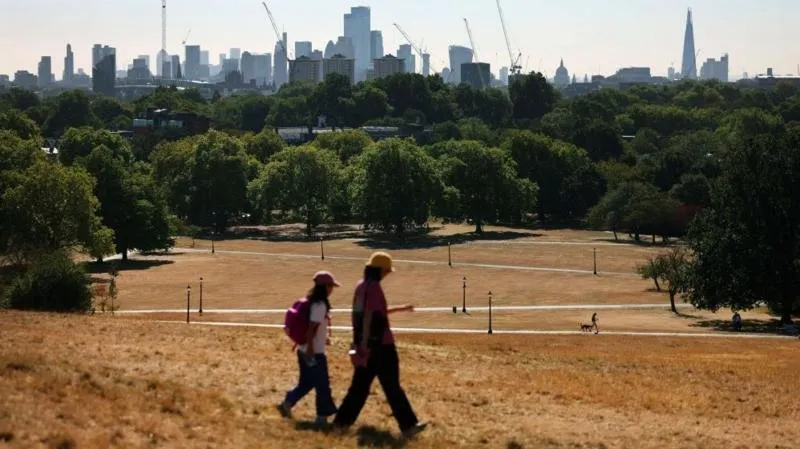
People walk through a dry, yellowed park in London during the record-breaking summer heat.
The United Kingdom has recorded its hottest summer in history, with the UK Health Security Agency estimating over 5,000 heat-related deaths. Driven by persistent heat domes, the extreme weather has prompted government officials to call for a fundamental shift in how the nation prepares for summer health risks. The crisis has also intensified the national debate on long-term climate adaptation.
- Estimated heat-linked deaths5,258
- Hottest day of 202638.2C (Gloucestershire)
- Deadliest period21-28 June (2,401 deaths)
- Heat episodes (days >20C average)41 days
Photos
4 photosWhat happened
The United Kingdom has endured its most lethal summer on record, with the UK Health Security Agency (UKHSA)—the government body responsible for protecting against infectious diseases and environmental hazards—estimating that 5,258 people died due to heat-associated causes. This figure is more than double the previous record of 2,985 deaths set in 2022.
The extreme conditions were defined by a series of heatwaves that saw temperatures repeatedly climb toward record-breaking levels. The UKHSA recorded 41 days of 'heat episodes' between May and August, defined as days where the average Central England Temperature (CET) reached at least 20C.
How it unfolded
The summer was marked by recurring 'heat domes,' which are stalled areas of high pressure that trap hot air over a region. These systems led to record-breaking heatwaves in May, June, and August. In May, temperatures at Kew Gardens reached 35.1C, smashing previous monthly records by over 2C.
The deadliest period occurred in late June, resulting in an estimated 2,401 deaths as temperatures peaked at 38C. By August, the heat intensified further, with Hartpury College in Gloucestershire recording 38.2C, the highest temperature of the year. While these figures were extreme, they remained below the all-time UK record of 40.3C, set in Coningsby, Lincolnshire, on 19 July 2022.
Why it matters
The scale of the mortality rate has forced a shift in national policy. The government is now treating summer heat as a major public health threat comparable to the challenges faced during winter. The lack of rainfall also triggered widespread droughts across Wales and most of England, alongside significant wildfire damage, highlighting the vulnerability of the nation's infrastructure to a warming climate.
Health Secretary Yvette Cooper has officially requested that the National Health Service (NHS) begin preparing for summer with the same level of intensity as its winter planning. This reflects a growing consensus that the UK's current infrastructure, including housing and healthcare settings, is not adequately equipped for the warming climate.
The background
The UKHSA and climate experts have long warned that climate change would increase the length, frequency, and intensity of extreme heat in the UK. The summer of 2026 is being described as 'exceptional,' not only for its temperatures but for the duration of the heat episodes.
Prime Minister Andy Burnham, speaking at the COP31 climate summit, noted that the weather patterns experienced this year are no longer considered 'normal.' The government is now emphasizing the need for 'longer-term adaptation,' which involves retrofitting homes and public buildings to better withstand extreme temperatures.
What we still don't know
While the UKHSA has provided a total estimate of heat-linked deaths, the specific breakdown of these casualties—such as age, underlying health conditions, or geographic distribution—remains limited. Furthermore, while the government has signaled a shift in policy, the specific financial commitments and structural changes required to adapt the nation's housing and healthcare settings to these new climate realities have yet to be detailed.
Want more on this story? Our research assistant searches the latest reports across the web and explains what it finds, so you get the fuller picture in one place.