
Leaked Russian Statistics Reveal Massive Human Toll of the Ukraine War
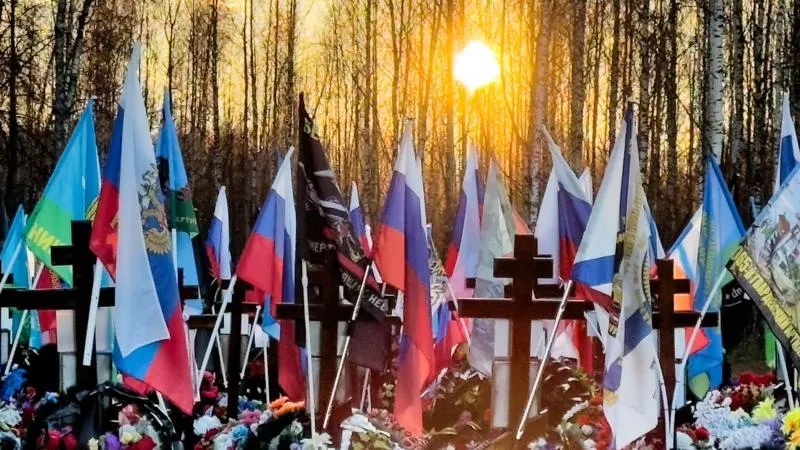
Russian flags and memorial crosses marking the graves of fallen soldiers.
Leaked data from Russia's federal statistics agency analysed by investigative journalists indicates that at least 490,334 Russian soldiers have died since the full-scale invasion of Ukraine in 2022. The records expose deep demographic shifts, disproportionate losses in impoverished regions, and a human cost far exceeding official government acknowledgments. While the Kremlin dismisses external data, the leaked files closely mirror independent open-source tallies.
- WhenFebruary 2022 to September 2026
- WhereUkraine and Russian border regions
- CasualtiesAt least 490,334 Russian soldiers dead (estimated true toll up to 644,471)
- StatusLeaked government data verified against 11 million death records and open-source lists
Photos
20 photosWhat happened
An analysis of leaked death records from Russia's federal statistics agency, known as Rosstat, has revealed that at least 490,334 Russian military personnel have died since the beginning of the full-scale invasion of Ukraine in 2022. The data, spanning from 2021 to September 2026, became accessible following a cyber-attack executed by the Belarusian hacker group Cyber Partisans BY and Ukraine's Silent Crow.
While Russia's statistics agency acknowledged the cyber-attack, it denied that any protected information had been compromised. Meanwhile, Kremlin spokesman Dmitry Peskov asserted that only the Russian defence ministry holds the authority to report casualty data, advising that no other figures be taken into account. The defence ministry itself has refrained from publishing official casualty numbers for several years.
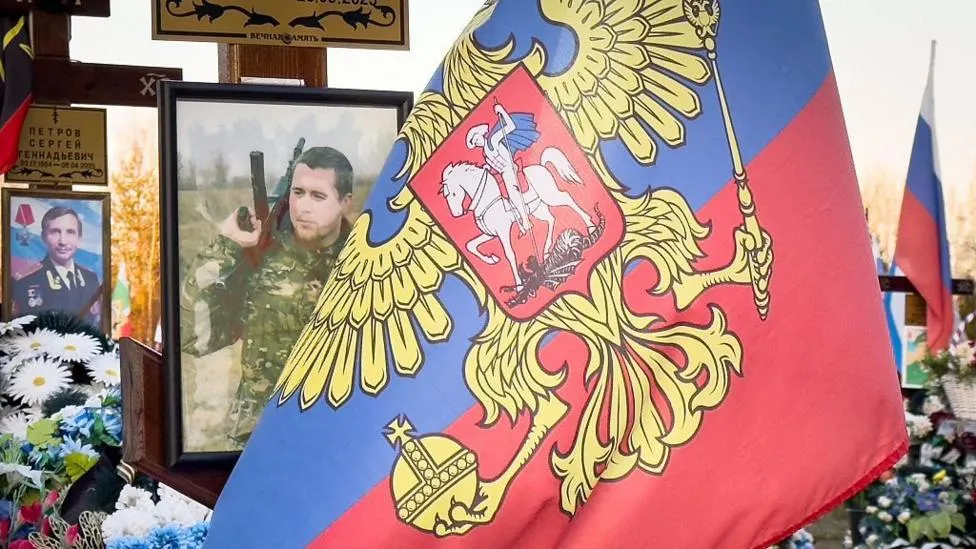
A framed portrait of a deceased Russian soldier displayed alongside the national flag.
How it unfolded
Journalists compared more than 11 million death records from the Rosstat leak against an established open-source list of confirmed military deaths, finding matches for 90% of the records. Military experts estimate that open-source lists—compiled from official reports, social media, new memorials, and graves—account for roughly 45% to 55% of the true death toll, suggesting actual fatalities could range between 527,295 and 644,471.
To ensure accuracy in analysing the leaked files, researchers filtered entries by location to include only Ukraine and Russian border regions affected by incursions. They isolated entries explicitly indicating military-related causes of death, excluded women and individuals outside the 18-65 age group to filter out civilians, and accounted for missing soldiers recorded through court rulings when bodies were unrecovered from combat zones.
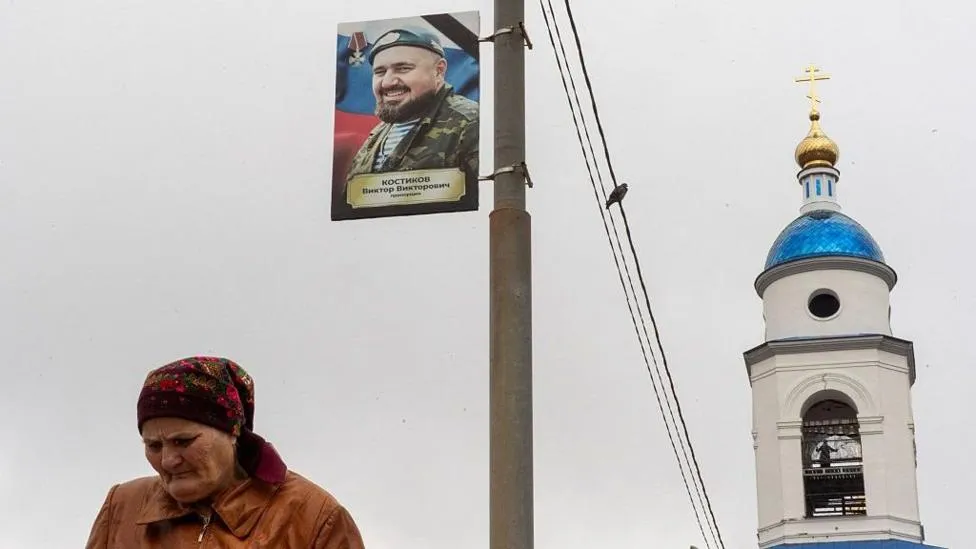
A local resident near a memorial poster and an Orthodox church.
The people involved
The human cost of the conflict has fallen unevenly across Russian society and demographic groups. According to the data, 65% of Russians aged 18 to 24 who lost their lives in 2025 died in the war, while the figure stands at 59% for those aged 25 to 34. Among younger cohorts, the conflict has become the leading cause of mortality, surpassing cardiovascular disease in all demographics except for those aged 45 to 54.
Geographically, some of Russia's poorest regions in Eastern Siberia have suffered disproportionately. Men hailing from Tyva, Buryatia, and Zabaykalsky Krai are reported to be 20 to 25 times more likely to perish in the war than residents of major metropolitan centers like Moscow and St Petersburg. Additionally, the analysis identified at least 5,017 foreign nationals fighting for Russia, including substantial numbers from Uzbekistan and Tajikistan.
Why it matters
The revelation of these figures underscores the immense demographic and social transformation occurring within Russia as the conflict approaches its fifth year. A war initially anticipated by leadership to last only days has instead generated casualty rates that dwarf historical precedents, such as the Soviet war in Afghanistan during the 1980s, where approximately 15,000 Red Army troops died over a ten-year period.
The heavy concentration of fatalities among young working-age men and economically disadvantaged regions threatens long-term structural damage to Russia's workforce and regional stability. Furthermore, the stark divergence between official silence and leaked statistical realities highlights the severe information controls maintained by Moscow regarding the true human price of its military campaign.
The background
Relations between Russia and Ukraine deteriorated sharply following the annexation of Crimea in 2014 and escalated into a full-scale invasion in February 2022. For years, the Russian government has strictly controlled information surrounding military casualties, eventually halting the publication of external cause-of-death data by Rosstat two years ago to obscure the rising death toll.
Independent journalistic projects and open-source investigators have increasingly relied on digital footprints, satellite imagery, social media memorials, and now leaked administrative databases to quantify the losses. On the opposing side, Ukrainian leadership and independent monitoring groups have similarly attempted to track their own military and civilian casualties amid ongoing hostilities.
What we still don't know
Despite the unprecedented scope of the leaked database, exact figures remain subject to estimation and incomplete accounting. The Rosstat dataset contains no individual names and may omit certain categories of personnel, such as dual nationals listed strictly as Russians or specific foreign auxiliary forces whose service is undocumented in standard domestic files.
The ultimate total of both Russian and Ukrainian casualties remains fluid as intense fighting continues along multiple fronts, and official transparency from government ministries remains absent.
Want more on this story? Our research assistant searches the latest reports across the web and explains what it finds, so you get the fuller picture in one place.