
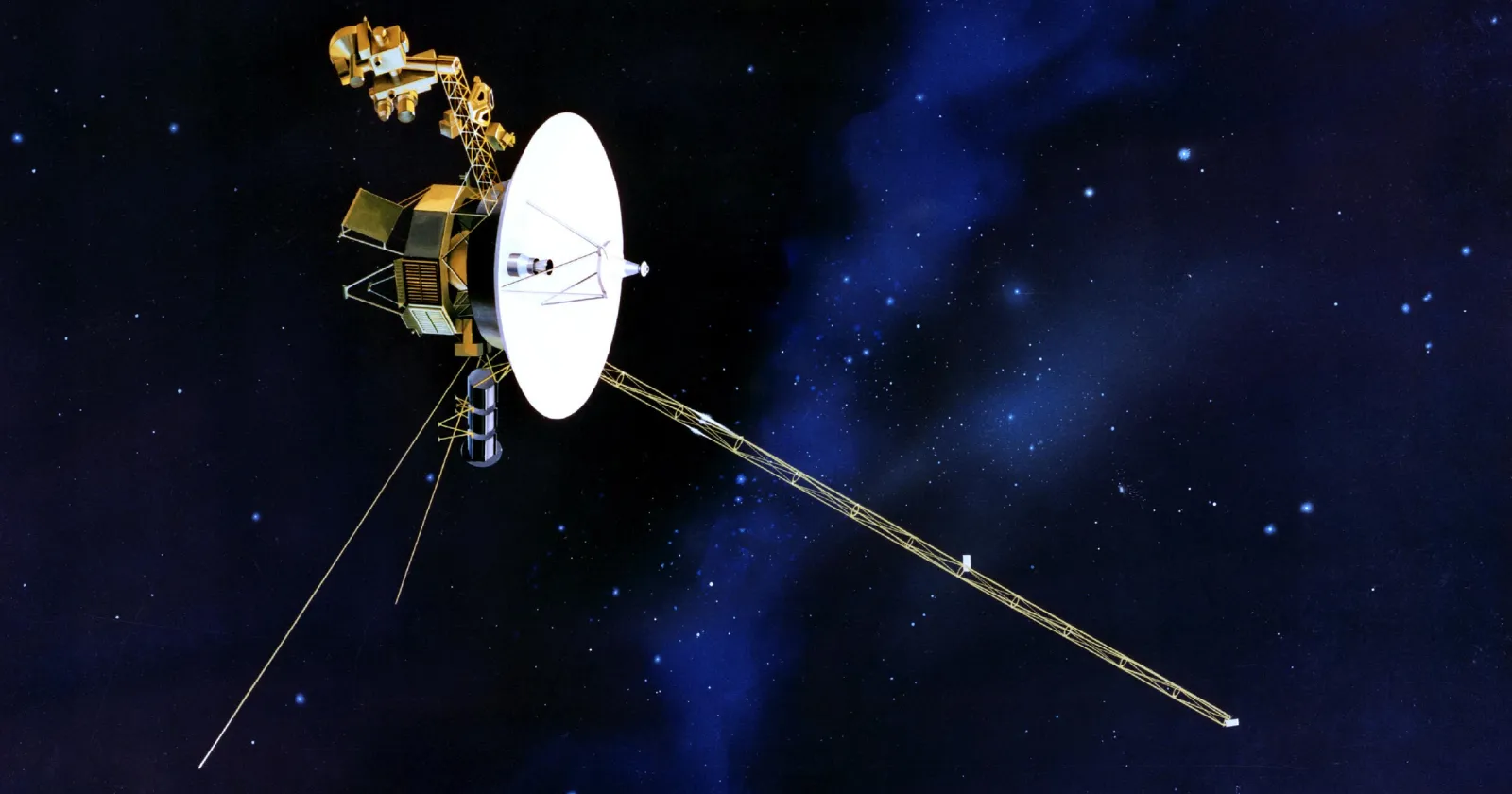
NASA's Voyager 1 spacecraft has crossed a historic boundary in space exploration, reaching a distance of one light-day from Earth. This milestone places the probe roughly 16.1 billion miles away, making it the most distant human-made object in history.
Because light is the fastest thing in the universe and covers about 186,000 miles every second, it now takes a full 24 hours for radio signals to travel from Earth to Voyager 1. Every command sent by NASA and every reply from the spacecraft requires a full day each way, creating a 48-hour round trip for communication.
What happened
The milestone was reached at 5:16 a.m. Eastern time on Wednesday, November 18, 2026. Launched nearly five decades earlier on September 5, 1977, from Cape Canaveral, Florida, aboard a Titan-Centaur rocket, Voyager 1 has been hurtling through the cosmos ever since. It currently travels outward from the solar system at roughly 38,000 miles per hour, pointed toward the constellation Ophiuchus.
Operating the spacecraft now requires meticulous planning by teams at NASA's Jet Propulsion Lab, managed by Caltech. Because communication is so delayed, project managers must think and plan in days rather than minutes. As project manager Suzy Dodd noted, a command sent on a Monday morning will not yield a response until Wednesday morning.
To communicate across 16 billion miles, NASA relies on the Deep Space Network, a collection of giant dish antennas in California, Spain, and Australia. Voyager 1 transmits using a radio transmitter of about 23 watts—roughly the power of a refrigerator light bulb—meaning its signal fades to a mere whisper by the time it reaches Earth. Data is received at a trickle of around 160 bits per second, slower than a dial-up modem.
Why it matters
Reaching a distance of one light-day demonstrates the extraordinary longevity and endurance of early space exploration hardware. Voyager 1 was originally designed for a modest five-year mission to study Jupiter and Saturn. Instead, it has outlived its planned lifespan by decades, rewriting human understanding of the solar system's boundaries.
The mission provides unique, irreplaceable scientific data from deep space. However, managing the spacecraft is an exercise in extreme conservation. Voyager 1 is powered by a radioisotope thermoelectric generator, which turns heat from decaying plutonium into electricity. Because the plutonium weakens every year, the spacecraft loses about 4 watts of power annually.
To keep the probe alive, engineers have systematically shut down heaters and science instruments over the decades. In April 2026, the team turned off the Low-energy Charged Particles experiment to buy the mission about another year of breathing room. Only two science instruments remain operational: one listening to plasma waves and one measuring magnetic fields.
The background
Voyager 1's journey began during an era when computer technology was in its infancy. The spacecraft possesses about 69 kilobytes of memory in total, which is less than a single photograph on a modern smartphone. Engineers still maintain it using code written nearly half a century ago.
During its primary planetary mission, Voyager 1 flew past Jupiter in 1979 and Saturn in 1980, sending back close-up images of storms, rings, and moons. In 1990, it turned its camera around from 3.7 billion miles away to capture Earth as the iconic 'Pale Blue Dot.' Shortly after, its cameras were powered down to save energy.
In August 2012, Voyager 1 crossed the heliopause, the outer edge of the Sun's bubble of charged particles, officially becoming the first spacecraft to enter interstellar space. Its twin, Voyager 2, launched 16 days earlier, took a different trajectory and is expected to reach the one-light-day milestone in November 2035.
Both spacecraft carry a Golden Record, a message from Earth containing sounds, images, and greetings conceived to communicate with any extraterrestrial intelligence that might encounter the probes billions of years from now.
What happens next
Voyager 1 is not slowing down and has no specific navigational target for the future. Even at its current speed of 38,000 mph, it would need roughly another 17,000 years to cover a single light-year.
Eventually, its decaying plutonium power source will drop too low to run its remaining instruments or its radio transmitter, at which point the spacecraft will fall silent. Until that day arrives, it will continue drifting outward into the void, carrying humanity's golden message deep among the stars.
Key takeaways
- Voyager 1 has become the first human-made object to reach a distance of one light-day, or approximately 16.1 billion miles, from Earth.
- Radio communications with the spacecraft now experience a 48-hour round trip, requiring NASA engineers to plan commands days in advance.
- Launched in September 1977, the spacecraft relies on 1970s technology with just 69 kilobytes of total memory.
- Continuous power loss from decaying plutonium has forced NASA to shut down most onboard instruments, leaving only two science systems still operating.