
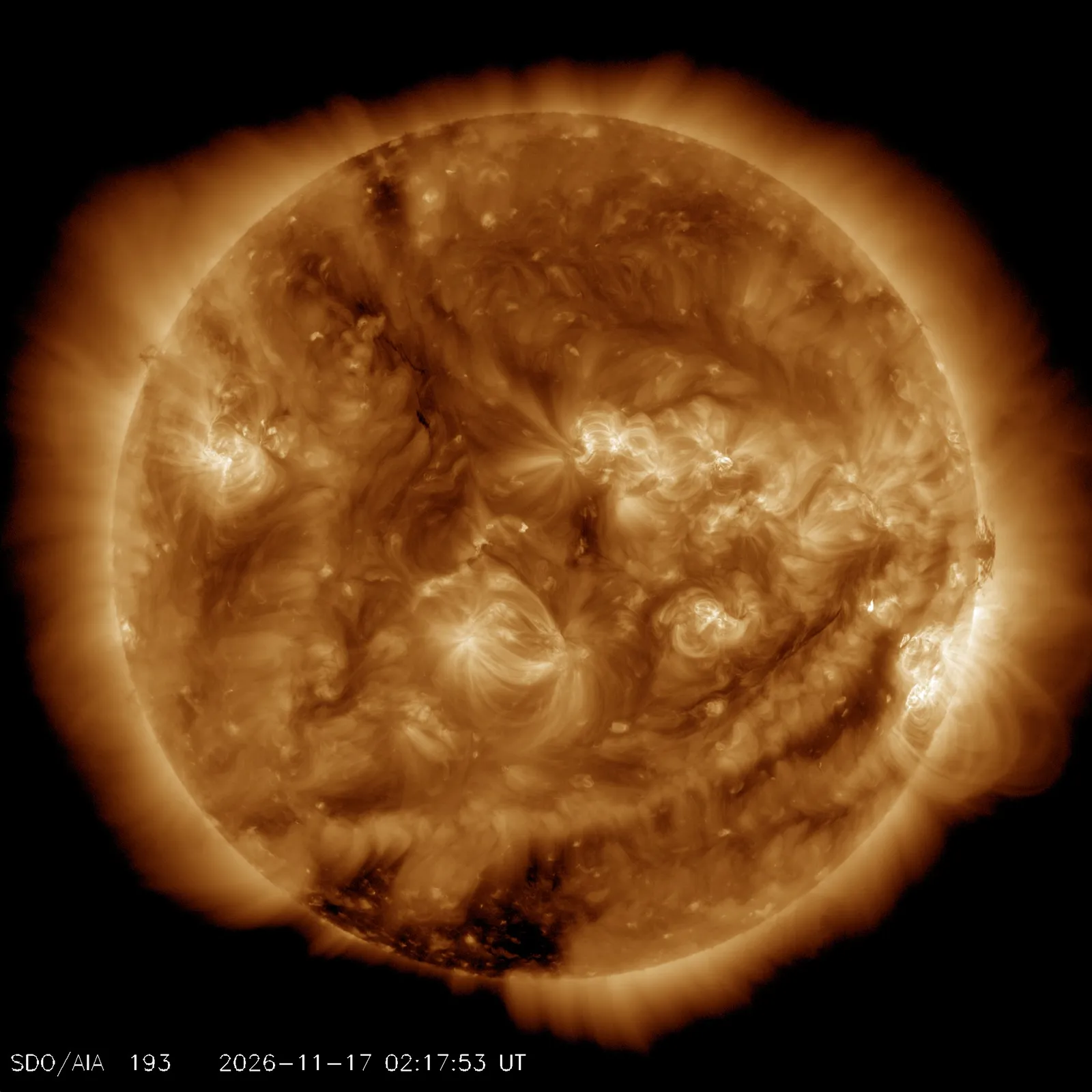
Federal space weather forecasters have issued a minor geomagnetic storm warning for the middle of November. The activity is expected to bring brief disruptions and potential northern lights displays to high latitudes.
What happened
NOAA's Space Weather Prediction Center is forecasting isolated G1 or minor geomagnetic storms late on November 17 and early on November 18, 2026. Forecasters expect the planetary Kp index, a scale used to measure geomagnetic activity, to reach 4.67 during the three-hour period from 21:00 UTC on November 17 to 03:00 UTC on November 18. This matches a G1 watch that has remained in effect since November 15.
The solar activity is driven by two main factors. First, a positive-polarity coronal hole high-speed stream is moving into a geoeffective position, meaning it is aligned to impact Earth's magnetic field. Second, forecasters note a potential glancing blow from a coronal mass ejection, or CME, which is a massive expulsion of plasma and magnetic field from the Sun. This CME left the Sun on November 14, marked by a Type II radio emission with an estimated speed of 1,972 kilometers per second. However, forecasters maintain low confidence regarding the CME's impact.
Why it matters
G1 is the lowest category on NOAA's geomagnetic storm scale, meaning its effects are generally minor. At this level, weak power grid fluctuations can occur, and minor impacts on satellite operations are possible. Observers at high latitudes may also be able to see auroras, commonly known as the northern lights. These displays could stretch into the northern tier of the United States, including states like Maine and northern Michigan.
What happens next
Geomagnetic activity is expected to ease back toward unsettled conditions by November 19 as the high-speed solar stream and potential CME move past Earth.
Key takeaways
- NOAA's Space Weather Prediction Center forecasted a G1 minor geomagnetic storm for late November 17 and early November 18, 2026.
- The activity is expected to push the planetary Kp index to 4.67 during the peak window.
- The minor storm is triggered by a high-speed solar stream and a low-confidence glancing blow from a coronal mass ejection that erupted on November 14.
- Impacts are minimal, limited to weak power grid fluctuations, minor satellite effects, and possible northern lights in high-latitude regions.