
Superpower Summit in Shenzhen Yields Joint Peace Declaration
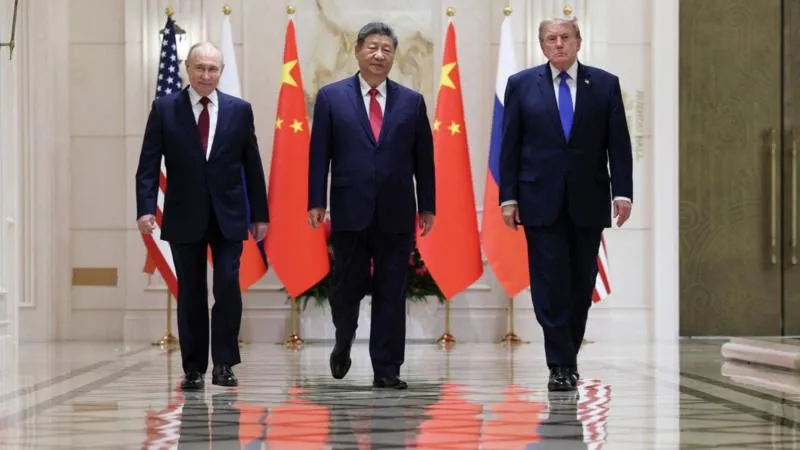
Russian President Vladimir Putin, Chinese President Xi Jinping, and US President Donald Trump walk together after their trilateral meeting in Shenzhen.
The leaders of the United States, Russia, and China have convened for historic trilateral talks in Shenzhen, China, issuing a joint declaration on global security, nuclear deterrence, and resource production. While the summit produced high-level diplomatic optics, substantive breakthroughs on active geopolitical conflicts remained scarce.
- WhoUS President Donald Trump, Russian President Vladimir Putin, and Chinese President Xi Jinping
- WhereShenzhen, China
- WhenThursday, during the APEC summit
- WhatFirst trilateral talks and joint peace declaration
What happened
In a rare gathering of global superpowers, US President Donald Trump, Russian President Vladimir Putin, and Chinese President Xi Jinping met for 90 minutes in the south-eastern Chinese city of Shenzhen on Thursday. The discussions occurred on the sidelines of the Asia-Pacific Economic Cooperation summit and marked the first trilateral talks between the three nations' leaders.
Following the sit-down, the three leaders issued a joint declaration addressing global security, nuclear proliferation, energy supplies, and international legal bodies. The statement emphasized that nuclear war cannot be won and must never be fought, while also outlining plans to increase petroleum and gas production.
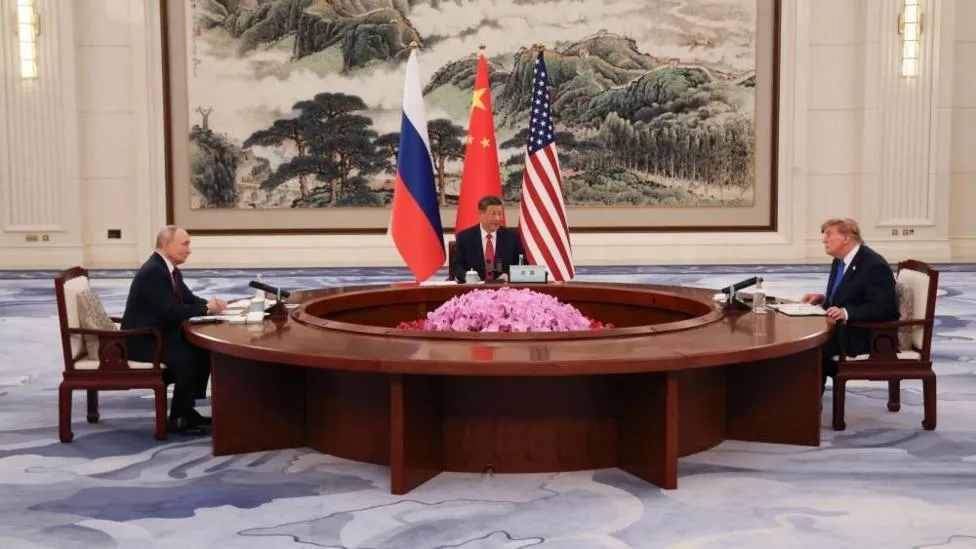
The three leaders seated around a circular conference table during discussions in China.
How it unfolded
Ahead of the three-way meeting, President Trump held separate bilateral discussions with Putin—their first encounter since August 2025—and with Xi, characterizing his relationships with both leaders in warm terms. The main trilateral session then proceeded behind closed doors, followed by public statements from the participating heads of state.
Upon concluding the meetings, President Trump immediately boarded Air Force One for his return flight to Washington, utilizing social media to announce an upcoming press conference at the White House. Meanwhile, Putin addressed reporters in China to discuss regional security and the ongoing conflict in Ukraine.
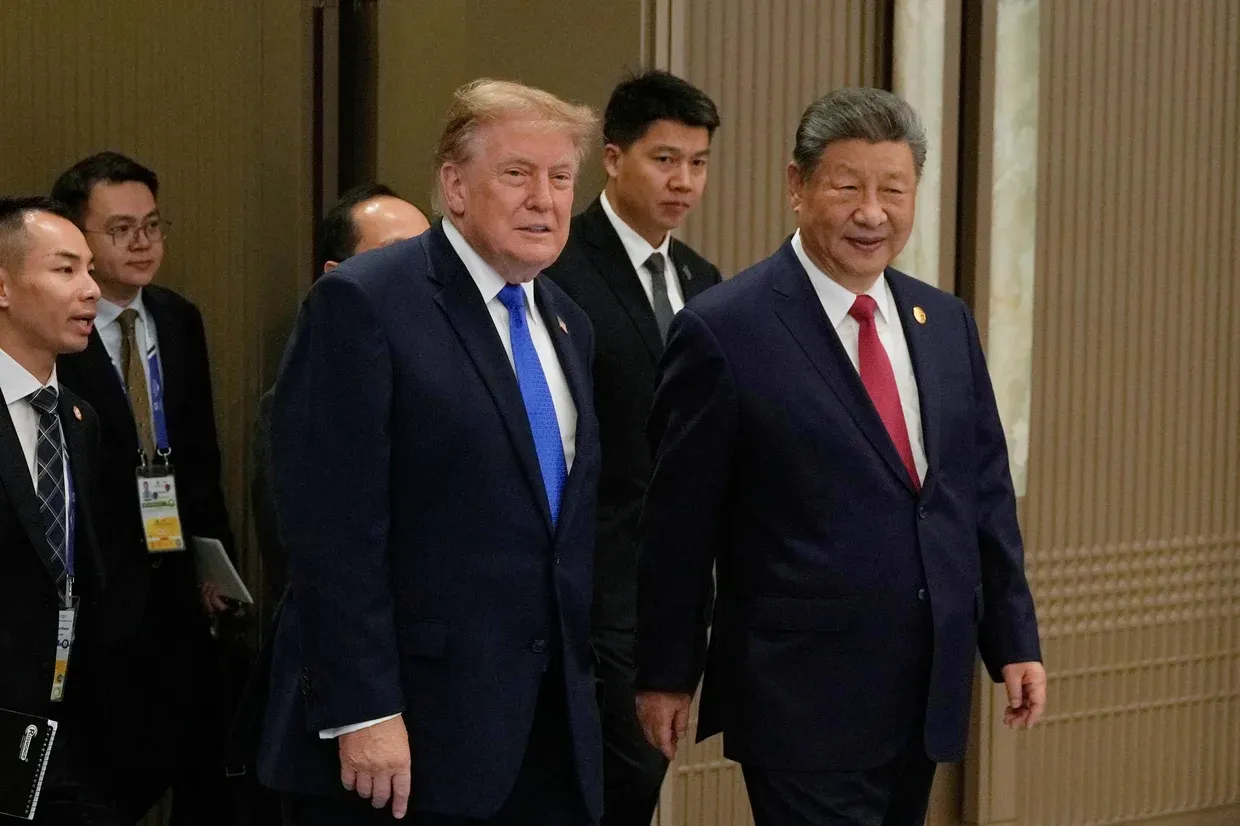
President Trump and President Xi Jinping walking together during the summit events.
What the reports confirm
Both reports corroborate that the three leaders agreed on a joint statement affirming their commitment to strategic stability, UN reform, and opposing the perceived overreach of international legal institutions like the International Criminal Court. They also uniformly confirm that the leaders agreed that nuclear conflict must be avoided.
However, the accounts diverge in emphasis. One report details concurrent military developments in Eastern Europe, including drone attacks on Kyiv and threats regarding the Crimean bridge, while the other places greater focus on domestic American political reactions and international trade, tariff, and technology discussions involving artificial intelligence and semiconductor supply chains.
The people involved
Donald Trump serves as the President of the United States, advocating for negotiated settlements to global conflicts and closer great-power dialogue. Vladimir Putin, the President of Russia, utilized the summit to outline Moscow's positions on European security and deterrence. Xi Jinping, the President of China, hosted the gathering in Shenzhen and stressed the necessity of major-power interaction.
The summit also drew reactions from US lawmakers, including Republican Senator John Curtis and Democratic Senator Tim Kaine, who voiced concern over the diplomatic warmth extended to foreign adversaries, contrasting with sharp rebukes from other congressional leaders.
Why it matters
The trilateral summit represents a significant diplomatic pivot among the world's most powerful nuclear-armed states, potentially reshaping international alliances and security architectures. By issuing joint declarations on petroleum output and nuclear risk reduction, the nations signal a willingness to coordinate on macro-economic and strategic fronts despite deep-seated regional disagreements.
At the same time, the spectacle has alarmed traditional allies and domestic lawmakers who worry that engaging adversaries without securing concrete concessions on ongoing conflicts—such as the war in Ukraine—undermines collective security and weakens established democratic coalitions.
The background
The meeting took place against the backdrop of protracted geopolitical friction, most notably Russia's full-scale invasion of Ukraine initiated in 2022, which has strained relations between Moscow and Western capitals. China has maintained an officially neutral stance on the conflict while facing Western scrutiny over dual-use technology exports.
Additionally, relations between the United States and China have navigated complex economic tensions, including trade disputes, tariff adjustments, and heightened oversight of advanced technologies such as artificial intelligence and semiconductor chips.
Response and aftermath
Reaction from US lawmakers was sharply divided. While some legislators acknowledged the positive nature of commitments to prevent nuclear war, others criticized the public camaraderie displayed toward leaders involved in active military aggression. In Europe and Ukraine, observers expressed anxiety that high-level diplomatic overtures could lead to policy shifts detrimental to regional sovereignty.
In Russia, state media and domestic outlets framed the international gathering as a diplomatic victory that broke years of attempted Western isolation following the onset of the conflict in Ukraine.
What happens next
President Trump announced plans to host a press conference at the White House to provide further details regarding the outcomes of his trip to Asia. Meanwhile, diplomatic channels are expected to address the practical implementation of the joint declarations concerning energy production and nuclear risk reduction.
Broader international relations will also be tested by upcoming deadlines, including trade and tariff truces between major economies, as well as ongoing international debates surrounding regional security in Europe and the Asia-Pacific.
What we still don't know
Specific mechanisms and timelines for increasing petroleum and gas production have not been detailed. Furthermore, it remains unclear whether the stated commitments to reduce nuclear risks will translate into formal bilateral or trilateral arms control negotiations.
The exact nature of any private understandings reached concerning regional conflicts, such as the war in Ukraine or tensions involving Taiwan and Iran, has not been fully disclosed by the participating governments.
Want more on this story? Our research assistant searches the latest reports across the web and explains what it finds, so you get the fuller picture in one place.