
Russian Missile Lands in Poland as Massive Air Assault Hammers Ukraine
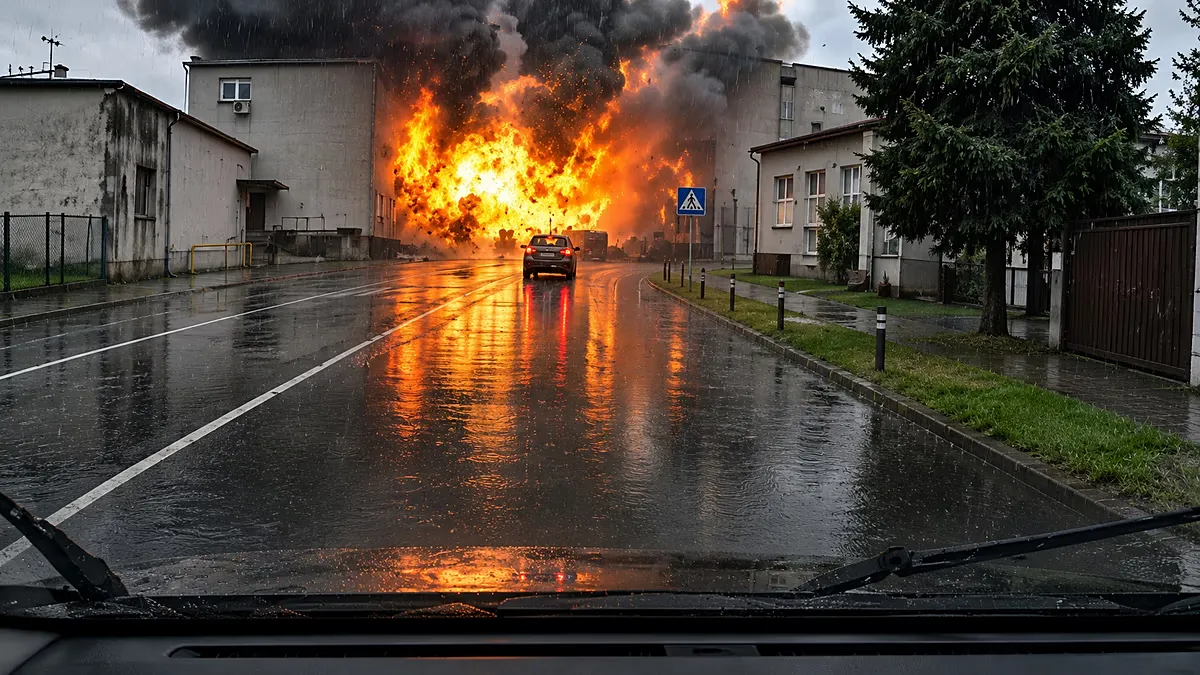
A rainy street view facing a fiery explosion and billowing smoke near buildings during the bombardment.
A Russian Kh-101 missile landed in Poland during a massive nighttime bombardment by Moscow across Ukraine that killed at least eight civilians and crippled power grids. Polish Prime Minister Donald Tusk called the incident a deliberate provocation, while NATO officials condemned it as a grave airspace violation. The fiery escalation comes amid ongoing, U.S.-brokered talks to end the nearly five-year war.
- WhenFriday
- WherePoland and Ukraine
- CasualtiesAt least eight civilians killed, over two dozen wounded
- Weapons involvedOver 400 drones and 110 missiles, including Kh-101, ballistic, and cluster munitions
- StatusInvestigation underway; diplomatic tensions escalating
Photos
9 photosWhat happened
A Russian Kh-101 missile landed inside Poland on Friday, striking approximately 37 miles from the Ukrainian border. The crash site was located roughly 47 miles away from an area where thousands of European troops were engaged in unprecedented military exercises in southeastern Poland, preparing for a potential postwar stabilization mission in Ukraine.
Simultaneously, Russian forces unleashed a massive, prolonged nighttime barrage across Ukraine. According to Ukrainian President Volodymyr Zelenskyy, Moscow fired more than 400 drones and over 110 missiles—including ballistic missiles and some carrying cluster warheads—hitting targets across multiple regions.
How it unfolded
The intense aerial assault came hours after Russian President Vladimir Putin vowed to retaliate against Kyiv for earlier strikes this week on the Kerch Bridge, a vital supply link connecting occupied Crimea with the Russian mainland. Ukrainian officials confirmed that domestically produced drones and missiles were utilized in those bridge attacks.
As air raid sirens wailed, Russian missiles and drones hammered apartment buildings, medical facilities, warehouses, and transportation bridges. In Kyiv and the surrounding region, bridges utilized for military logistics were struck alongside missile assembly facilities, rocket fuel component plants, and drone production sites.
What the reports confirm
Reports confirm that a Russian Kh-101 missile breached Polish airspace and landed about 37 miles from the Ukrainian border, sparking an immediate security response involving military helicopters, rescue vehicles, and police roadblocks. Polish Prime Minister Donald Tusk stated that the incident appeared to be an intentional provocation coinciding with European military exercises.
Furthermore, reports corroborate that the nationwide bombardment killed at least eight Ukrainian civilians—including six in the capital, Kyiv—and wounded more than 27 others. Strikes on power plants, substations, and transmission networks severely damaged Ukraine's energy grid, forcing emergency outages across 11 regions and causing the country's three operational nuclear power plants to reduce power generation.
The people involved
Polish Prime Minister Donald Tusk led the condemnation of the missile landing, warning of a deliberate provocation. NATO Secretary-General Mark Rutte termed the event a 'grave violation' of Polish airspace and announced plans to visit Poland over the weekend.
U.S. President Donald Trump recently discussed the conflict at a summit in China with Russian President Vladimir Putin and Chinese leader Xi Jinping, according to envoy Steve Witkoff. Meanwhile, Trump's son-in-law and envoy Jared Kushner briefed European leaders on potential compromises regarding NATO-like security guarantees for a postwar Ukraine. Russian Deputy Foreign Minister Sergei Ryabkov commented on diplomatic formats, while Ukrainian Foreign Minister Andrii Sybiha and Deputy Energy Minister Artem Nekrasov detailed the widespread devastation to civilian and energy infrastructure.
Why it matters
The descent of a Russian missile onto Polish soil directly tests the security boundaries of the trans-Atlantic community and NATO, raising fears of the war spilling over into member nations. For millions of Ukrainian civilians, the coordinated targeting of power grids ahead of winter threatens basic survival, cutting off electricity and forcing emergency outages across 11 regions.
The escalation also jeopardizes ongoing, U.S.-brokered diplomatic initiatives aimed at negotiating an end to the nearly five-year conflict, widening the chasm between Moscow's vision for European security architecture and the demands of Kyiv and its Western allies.
The background
The conflict began with Moscow's all-out invasion of Ukraine nearly five years ago. Since then, Russia has frequently targeted Ukraine's critical infrastructure, including power plants and transmission grids, to weaken the country's defense capabilities and demoralize the population.
In recent weeks, Washington has attempted to inject momentum into peace talks, exploring potential compromises on security guarantees and postwar deployments. However, Moscow has adamantly opposed the deployment of European troops to Ukraine after any prospective peace deal, viewing them as legitimate military targets.
Response and aftermath
Following the missile landing, Polish authorities established temporary roadblocks and deployed rescue vehicles and military helicopters to investigate the debris field. NATO leaders strongly denounced the breach, with Secretary-General Mark Rutte scheduling a weekend visit to Poland.
In Ukraine, emergency services rushed to rescue survivors from shattered apartment buildings and extinguish fires at industrial and medical facilities. Ukrainian leadership remained defiant, dismissing Moscow's attempts to redraw international security norms through military force.
What happens next
Investigations into the missile debris in Poland are ongoing, with NATO Secretary-General Mark Rutte expected to arrive in the country over the weekend to consult with officials. U.S.-led diplomatic efforts are slated to continue, though no concrete date has been established for the next round of peace talks.
Meanwhile, Ukrainian repair crews face the daunting task of restoring power networks ahead of winter amidst ongoing aerial threats, while military analysts watch closely to see how NATO and Western leaders respond to the airspace violation.
What we still don't know
It remains unverified whether the Kh-101 missile that landed in Poland suffered a navigational failure or was purposefully directed across the border, though Polish leadership suspects intent. The full extent of structural damage and precise injury counts resulting from the debris landing in Poland have not been detailed.
Additionally, exact figures for all injured civilians across Ukraine beyond the initial reports of over two dozen remain incomplete as rescue operations proceed.
Want more on this story? Our research assistant searches the latest reports across the web and explains what it finds, so you get the fuller picture in one place.