
Internal Pressures Mount for a Ceasefire in Sudan
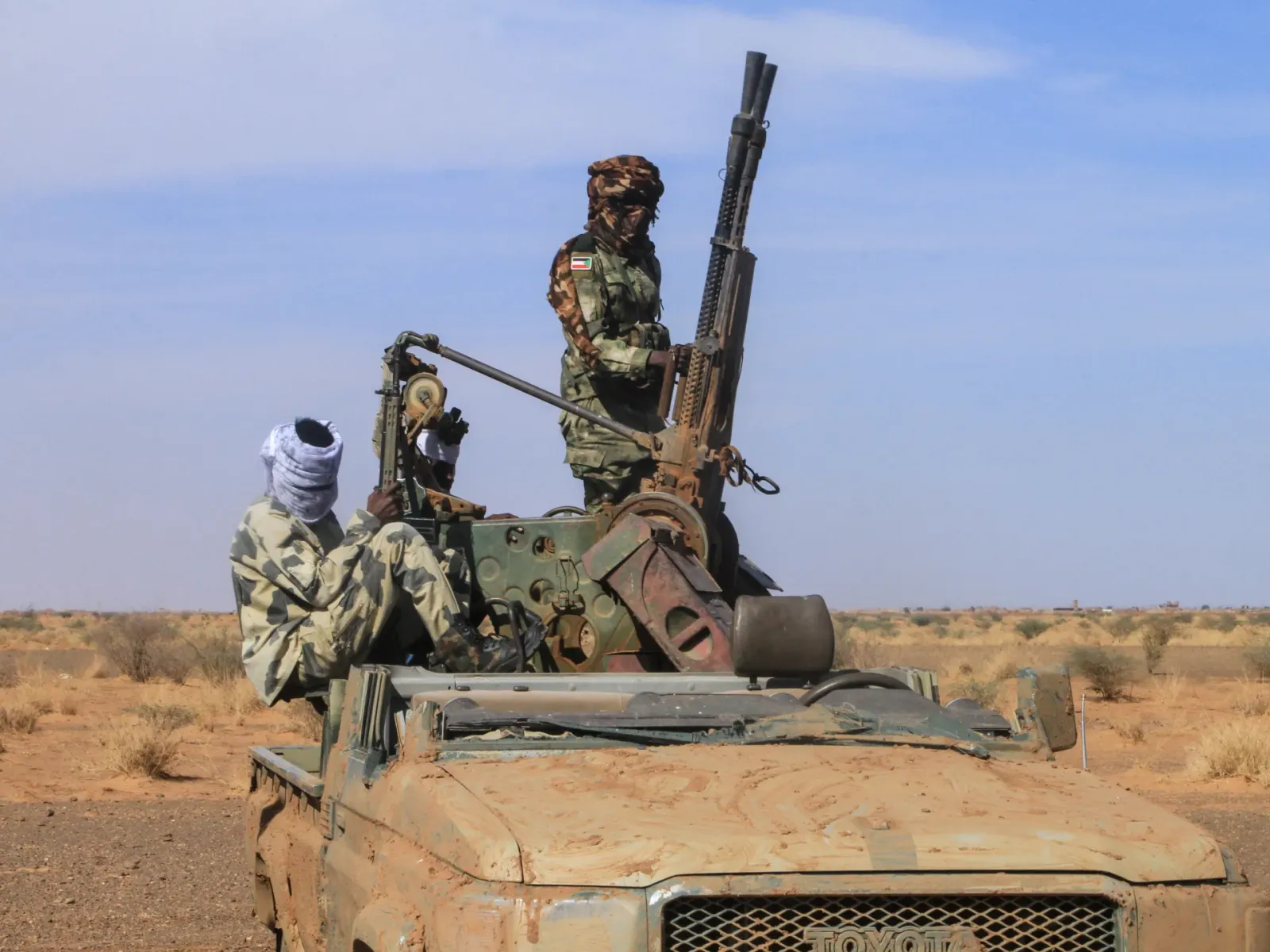
Armed fighters aboard a vehicle in a desert landscape during the ongoing conflict in Sudan.
More than three years into Sudan's devastating civil war, severe economic collapse and a spiraling humanitarian catastrophe are generating internal pressures for a ceasefire that international diplomacy failed to achieve. While the Sudanese army has advanced to control roughly two-thirds of the country, crippling inflation and a looming hunger crisis driven by Super El Nino rains threaten the population. Observers note that grassroots demands for peace and economic survival may finally force warring factions toward negotiations before the conflict's fourth anniversary.
- DurationMore than three years
- LocationSudan (including Khartoum, Blue Nile State, West Kordofan, and Darfur)
- Key FiguresArmy chief Abdel Fattah al-Burhan
- StatusSudanese army controls roughly two-thirds of the country; RSF paramilitary controls most of Darfur
- Humanitarian ImpactOver 40 percent of the population facing acute food insecurity
Photos
3 photosWhat happened
Sudan's civil conflict, which erupted more than three years ago, has plunged the nation into a deep multi-dimensional crisis marked by widespread displacement, infrastructure destruction, and a collapsing economy. Although international bodies and the United States have attempted to enforce ceasefires through sanctions and diplomatic pressure, the warring leadership initially showed little commitment to dialogue. However, firsthand reporting from Khartoum indicates that severe internal pressures—combining financial ruin, military maneuvers, and escalating humanitarian suffering—are beginning to shift the calculus toward a potential negotiated pause in hostilities.
While international flights have recently resumed to Khartoum from regional hubs like Cairo, Riyadh, and Doha, and foreign business groups arrive to scout reconstruction and mining deals, the domestic population faces extraordinary hardship. The Sudanese pound has plummeted to unprecedented lows, exceeding 10,000 to the US dollar compared to a pre-war average of 600. Long queues for petrol, soaring grocery costs, and electrical shortages have made daily survival grueling for returning displaced residents and urbanites alike.
How it unfolded
The trajectory of the conflict has been shaped by shifting military fortunes and economic decay. The Sudanese army, led by army chief Abdel Fattah al-Burhan, has made notable territorial gains in recent months, pushing back offensives in southeastern Sudan's Blue Nile State and advancing westward into West Kordofan, where the army and its allied Joint Forces recently retook the strategic town of el-Khuwei.
Simultaneously, the economic war machine that initially funded military operations has boomeranged into a primary source of national agony. Escalating costs have left farmers unable to afford basic agricultural inputs like fertilizer, leaving vast expanses of productive cropland fallow. Public discontent has begun bubbling to the surface through protests over transit costs in northern cities like Atbara—historically a crucible for anti-government agitation—forcing military leaders to recognize the tangible danger of widespread domestic uprisings.
The people involved
The primary military actors are the Sudanese Armed Forces, headed by General Abdel Fattah al-Burhan, and their opponents, the Rapid Support Forces (RSF) paramilitary. Al-Burhan has vowed to reclaim territory nationwide, consolidating the army's control over approximately two-thirds of the country.
On the other side, the RSF maintains near-total control over the western region of Darfur, a stronghold secured after capturing the North Darfur state capital of el-Fasher amid atrocities that United Nations fact-finding missions have characterized as bearing the hallmarks of genocide. Meanwhile, millions of displaced Sudanese civilians, returnees attempting to rebuild their lives, and business delegations from countries like Britain, Switzerland, and Saudi Arabia navigate the tense reality of a changing capital.
Why it matters
The convergence of financial collapse, military consolidation, and environmental shocks has pushed Sudan to the brink of catastrophe, making a ceasefire urgent for the physical survival of millions. More than 40 percent of the population is currently experiencing acute food insecurity, a situation severely compounded by this year's 'Super El Nino' weather phenomenon, which has disrupted seasonal rains and decimated expected harvests.
Without an immediate cessation of hostilities to allow a massive influx of humanitarian aid, hunger projections indicate the crisis will deteriorate drastically by mid-2027. Consequently, the pressure on Sudan's leaders to halt the economic freefall and secure a durable ceasefire is mounting from ordinary citizens exhausted by years of bloodshed.
The background
Sudan's modern instability is rooted in decades of political turmoil, culminating in a 2019 democratic revolution sparked by bread-price protests in Atbara that successfully unseated long-standing authoritarian rule. Subsequent transitions toward civilian-led governance collapsed when tensions between the regular military and the RSF paramilitary erupted into open warfare more than three years ago.
Since then, the conflict has displaced millions internally and across borders, shuttered agricultural production, and devastated urban centers, turning the capital of Khartoum into a ghost town for much of the conflict before recent commercial and infrastructural signs of life began to emerge.
Response and aftermath
Friendly nations such as Türkiye and Saudi Arabia have attempted to stabilize the situation through limited agreements aimed at securing fuel supplies and rehabilitating damaged energy infrastructure, though such support remains temporary. Meanwhile, the international community has primarily relied on economic sanctions and United Nations Security Council briefings to pressure the warring parties.
Domestically, public fatigue with the war has fueled embryonic discussions regarding inter-Sudanese dialogue, political reconciliation, and the eventual transfer of day-to-day governance and service delivery back to civilian authorities.
What happens next
As the Sudanese military expands its control to roughly two-thirds of the country and contemplates the arduous prospect of reclaiming Darfur from the RSF, the growing internal momentum for peace may force formal ceasefire negotiations before the war's fourth anniversary next April.
If internal pressures succeed where international diplomacy stalled, the coming months could see preliminary ceasefires that facilitate humanitarian aid delivery and open pathways for structured political reconciliation and future elections.
What we still don't know
Exact casualty statistics resulting from the multi-year conflict and recent military offensives remain unquantified by official reports. Furthermore, the precise mechanisms, timelines, and participants for the anticipated inter-Sudanese dialogue and civilian transition plans have not yet been formally established.
Want more on this story? Our research assistant searches the latest reports across the web and explains what it finds, so you get the fuller picture in one place.