
BepiColombo Nears Mercury After an Eight-Year Epic Voyage
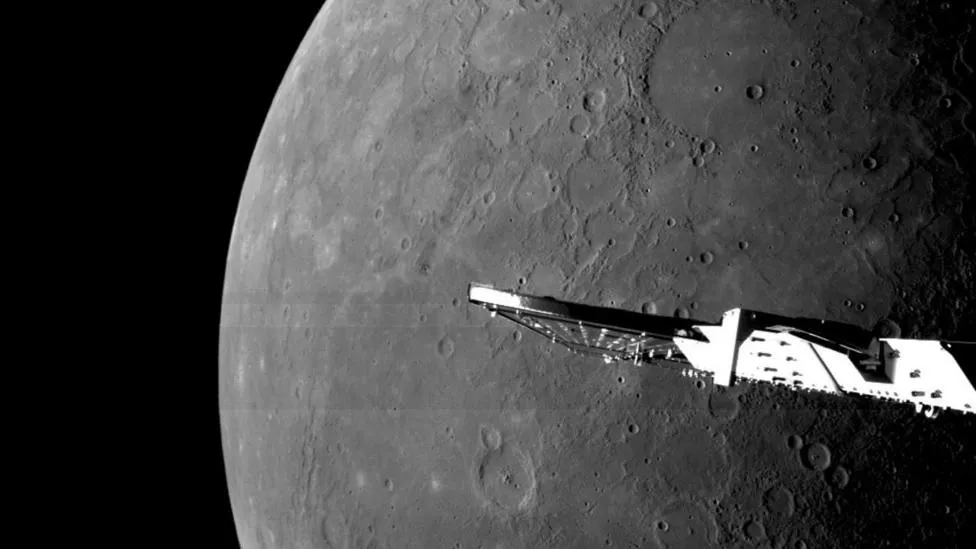
A spacecraft approaches Mercury, capturing the heavily cratered surface of the inner planet.
The joint European and Japanese spacecraft BepiColombo is about to enter orbit around Mercury after an eight-year, six-billion-mile journey through the inner Solar System. Facing extreme temperatures and intense solar radiation, the mission carries two separate orbiters designed to solve longstanding mysteries about the planet's surface and composition. The impending arrival marks only the third time humanity has sent a spacecraft to explore the innermost planet.
- MissionBepiColombo (ESA and JAXA joint collaboration)
- Launch Year2018 from French Guiana
- Journey LengthEight years, nearly six billion miles (10 billion km)
- DestinationMercury, the closest planet to the Sun
- Previous MissionsNASA's Mariner-10 and Messenger
What happened
The interplanetary spacecraft BepiColombo is on the verge of reaching its final destination, preparing to enter orbit around Mercury. Travelling nearly six billion miles (10 billion km) over eight years, the mission faces an extremely hostile environment characterised by intense solar radiation and extreme temperature swings.
Upon arrival, the spacecraft must execute a perilous 37-minute handbrake turn to allow Mercury's gravity to capture it. A failure in this maneuver could cause the craft to hurtle past the planet entirely.
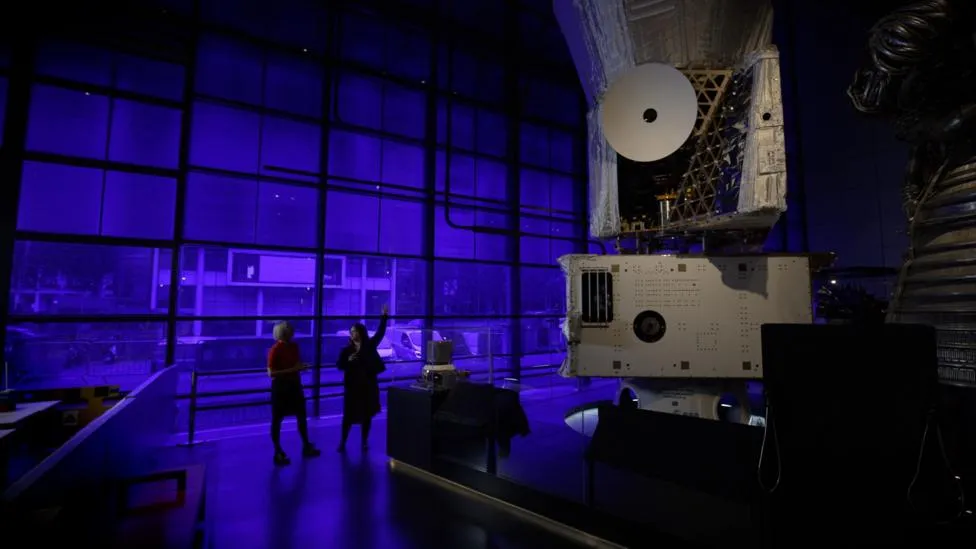
A life-size model of BepiColombo on display at the Science Museum in London.
How it unfolded
Launched in 2018 from French Guiana, BepiColombo embarked on a deeply convoluted path to counteract the Sun's immense gravitational pull. The spacecraft looped once around Earth, twice around Venus, and six times around Mercury to bleed off speed.
While the journey was originally planned to take seven years, a problem with the propulsion system extended the voyage by an additional year. Once safely in orbit, the mission will enter its next phase, involving the delicate separation of its two onboard craft.
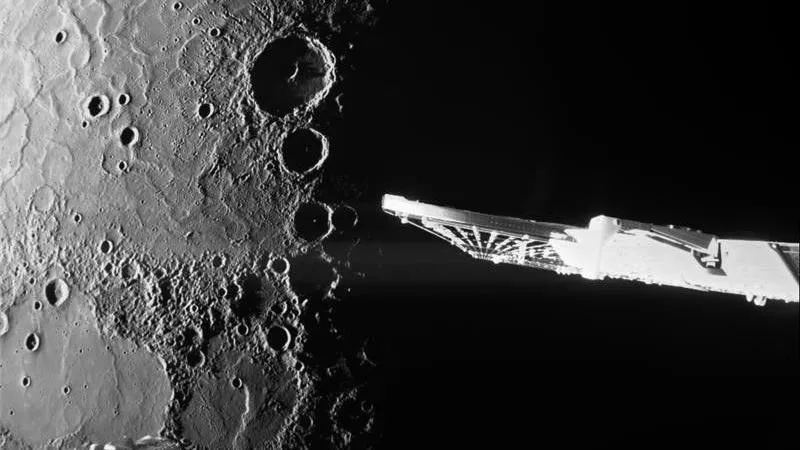
A view of the spacecraft's structural design against the cratered backdrop of Mercury.
The people involved
The mission is a major collaborative effort between the European Space Agency (ESA) and the Japanese Space Agency (JAXA). Researchers such as Professor Emma Bunce from Leicester University, a principal investigator on the mission, have championed the scientific value of exploring the inner Solar System's overlooked planet.
Engineering teams have also played a crucial role in preparing the hardware. Jessica Marshall, a systems engineer at Airbus—the company that built the spacecraft—noted that the impending separation of the two orbiters after eight years in space will be a nerve-wracking moment requiring a specially designed spring-and-twist release mechanism.
Why it matters
Mercury remains one of the least explored planets in our Solar System, despite holding crucial clues about planetary formation and evolution. Understanding how the planet interacts with the Sun's extreme space weather helps scientists model broader stellar and planetary dynamics.
Resolving questions about Mercury's oversized metal core, polar ice craters, and mysterious surface hollows could rewrite prevailing theories on how rocky planets form and evolve close to their parent stars.
The background
Mercury is the smallest rocky planet in the Solar System, sitting closest to the Sun where surface temperatures swing wildly from 430C to -180C. Due to its proximity, it experiences extreme solar radiation and possesses a disproportionately large metal core relative to its overall size.
Until now, only two NASA missions have ever visited the planet: Mariner-10, which flew past three times in the 1970s, and Messenger, which spent four years in orbit starting in 2011.
What happens next
Following orbital insertion, the mission will execute a "buy one, get one free" strategy by splitting into two separate spacecraft a few weeks later. One European craft will examine the planet's surface close-up, while the Japanese orbiter will observe from a distance.
Together, the paired orbiters will spend their mission investigating the planet's topography, magnetic field, and geological anomalies.
What we still don't know
Scientists have yet to explain several key geological features on Mercury, including the presence of ice in polar craters despite intense heat. Researchers are also baffled by thousands of shallow, steep-sided hollows dotting the surface that are estimated to be only about 100,000 years old.
Additionally, the exact origin of the planet's massive metal core remains an open question, with theories ranging from an early catastrophic "hit and run" collision that stripped away the mantle, to primordial formation in a metal-rich region of the early Solar System.
Want more on this story? Our research assistant searches the latest reports across the web and explains what it finds, so you get the fuller picture in one place.