
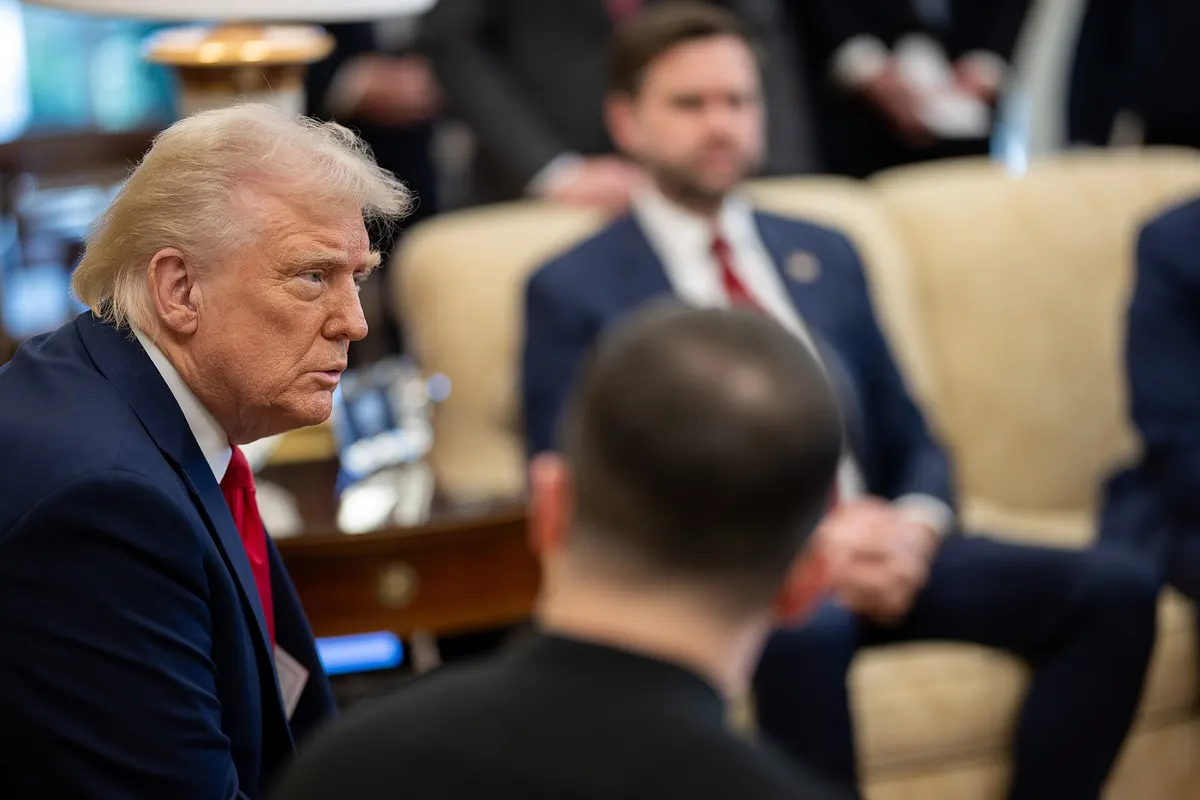
During a White House news conference on Friday, US Vice-President JD Vance stopped short of endorsing President Donald Trump's claim that Iran was on the verge of obtaining a nuclear weapon in February. The exchange followed a public rift over the political fallout from the ongoing conflict in the Middle East.
While Vance reaffirmed the broad administration goal of preventing Iran from acquiring nuclear capabilities, he refrained from backing the specific timeline used to justify the full-scale war. The president maintained that launching the military campaign was entirely necessary.
What happened
The tension between the two leaders stems from comments Vance posted on social media the morning after the recent midterm elections, where he bluntly stated that the war in Iran was the direct reason Republicans lost the Senate. Vance challenged supporters of the conflict to argue that losing the Senate for the next six years was a worthwhile cost.
In the White House briefing room on Friday, Trump was questioned about reports that he was unhappy with Vance's blunt post-election assessment. Trump denied being unhappy, stating that Vance's post was fine, but added that he would have explicitly answered affirmatively if asked whether he would launch the war again to prevent Iran from getting a nuclear weapon.
When a reporter subsequently asked Vance whether he would argue that the war was worth the political cost, the vice-president did not endorse the justification that the war was essential to stop an imminent nuclear threat. Instead, Vance stated that it was not his place to second-guess the president, emphasizing that his job is to support the commander-in-chief, who ultimately makes the decisions.
Why it matters
The public divergence between the president and the vice-president highlights deep internal friction within the administration over a major military conflict that has reshaped American domestic politics. With Republicans losing the Senate for the next six years as a direct consequence of the war, the administration faces intense scrutiny over both its strategic rationale and its electoral price.
The background
Donald Trump's justification for the full-scale war on Iran—which began early on 28 February 2026 with a video statement from Mar-a-Lago—has shifted repeatedly over time. At a campaign rally in Alaska last month, Trump insisted that the US had to join Israel in attacking Iran in February because the nation was just two weeks away from having a nuclear weapon.
That claim stands in sharp contrast to public testimony given to Congress on 25 March 2025 by his then director of national intelligence, Tulsi Gabbard. Gabbard testified that US intelligence agencies assessed Iran had not tried to make a nuclear weapon for more than two decades, and that Supreme Leader Ali Khamenei had not authorized the nuclear weapons program he suspended in 2003.
Despite that intelligence assessment, Trump ordered the bombing of Iran's nuclear enrichment facilities on 21 June 2025, declaring them completely and totally obliterated in what he called a spectacular military success. Eight months later, however, he announced a full-scale war to ensure Iran does not obtain a nuclear weapon.
What happens next
Neither the White House nor the vice-president's office has provided further comment on the public disagreement regarding the necessity of the war, leaving it unverified whether the administration's stated intelligence and military timelines will be formally reconciled.
Key takeaways
- Vice-President JD Vance stopped short of endorsing Donald Trump’s claim that Iran was close to obtaining a nuclear weapon in February.
- Trump stated during a White House press conference that he would wage the war against Iran again to prevent them from getting a nuclear weapon.
- Vance blamed the ongoing war in Iran for Republican losses in the recent midterm elections that cost the party the Senate for the next six years.
- Former director of national intelligence Tulsi Gabbard testified to Congress that intelligence agencies assessed Iran was not building a nuclear weapon.