
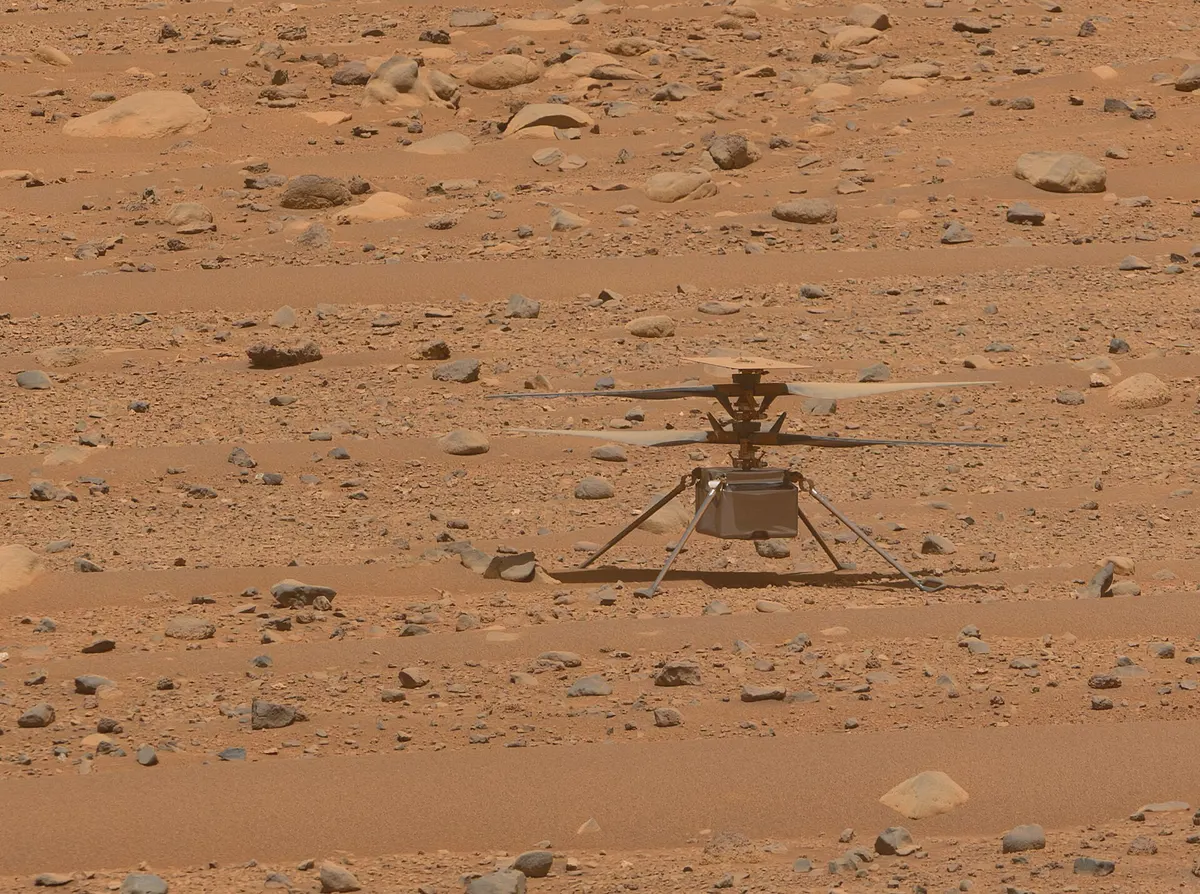
Two of NASA’s four active missions operating at Mars have suspended their science operations after running into separate technical issues. The affected spacecraft are the Perseverance rover and the Odyssey orbiter, both of which have been exploring the red planet far longer than originally planned.
The problems leave half of NASA's active Mars fleet sidelined while engineers on Earth attempt to troubleshoot the aging hardware. While both missions are well past their initial design lifetimes, they remain critical tools for exploring the Martian surface and relaying data back to Earth.
What happened
The troubles began when Perseverance experienced a communications failure on October 30. The rover has two redundant UHF radios used for high-rate data transfers to orbiters that beam information back to Earth, alongside a lower-rate direct-to-Earth X-band system. When the primary UHF radio failed to power up, the rover automatically switched to its backup and entered a protective safe mode. Ground teams at NASA’s Jet Propulsion Laboratory discovered that the backup radio was transmitting at only half its expected power output. Out of an abundance of caution, managers halted science operations and shifted to the slower X-band connection while investigating the issue.
Meanwhile, the situation for the Odyssey orbiter is more severe. In early November, one of the four reaction wheels used to point the spacecraft stopped spinning. Odyssey now has only two functioning wheels, having lost its first one back in 2013. The spacecraft requires at least three reaction wheels to maintain proper orientation toward the Sun and Mars. Without a third working wheel, Odyssey must rely entirely on its hydrazine thrusters to stay oriented. Ground teams have had some initial success troubleshooting the stuck wheel, but further testing is needed to see if it can be recovered.
Why it matters
The outages temporarily halt key scientific work on the Martian surface while threatening the operational future of NASA's longest-lived orbiter. Perseverance had recently broken a distance record for planetary driving, surpassing the 28.06-mile mark set by the Opportunity rover, and was actively studying a crater rim that once held an ancient lake. Its shift to direct-to-Earth X-band communications severely limits data transmission speeds, pausing its daily exploration.
For Odyssey, the stakes are existential. The orbiter was already running low on propellant, with project scientists previously hoping fuel would last through 2028 under normal conditions. However, relying purely on hydrazine thrusters instead of reaction wheels burns through fuel at a drastically accelerated rate. Engineers estimate the remaining propellant will last only one to two months without a functioning third wheel, potentially ending a mission that has operated since 2001.
The background
NASA maintains a fleet of orbiters and rovers at Mars to study the planet's geology, climate, and potential for past life, as well as to relay communications back to Earth. Odyssey arrived in orbit in 2001 and holds the record as the longest-lived Mars mission in history. Perseverance landed on the planet in its ongoing search for ancient microbial life, collecting rock and soil samples intended for a future return to Earth.
In addition to Perseverance and Odyssey, NASA operates the Curiosity rover, which has been active for 14 years, and the Mars Reconnaissance Orbiter. Other international craft, such as the European Space Agency's Mars Express and ExoMars Trace Gas Orbiter, also assist with communications relays. Spacecraft operating in the harsh Martian environment face extreme thermal shifts and persistent radiation, which can trigger component failures and computer reboots over long durations.
What happens next
NASA ground teams are focusing their initial troubleshooting efforts on recovering Perseverance's backup UHF radio before attempting to fix the primary unit. Mission managers remain hopeful that the rover can resume its normal science operations by the end of November.
For the Odyssey orbiter, engineers must determine whether the balky reaction wheel can be permanently recovered through further testing. If the wheel cannot be saved, the spacecraft faces a very short operational window before exhausting its remaining hydrazine propellant.
Key takeaways
- Two of NASA's four active Mars missions have suspended science operations due to separate hardware malfunctions.
- The Perseverance rover's communication system suffered a failure in its backup UHF radio, forcing a pause in science operations.
- Odyssey lost the use of a critical reaction wheel, leaving it heavily dependent on hydrazine thrusters and threatening to end its mission within months.
- Both affected spacecraft are operating well beyond their original design lifetimes in the harsh Martian environment.