
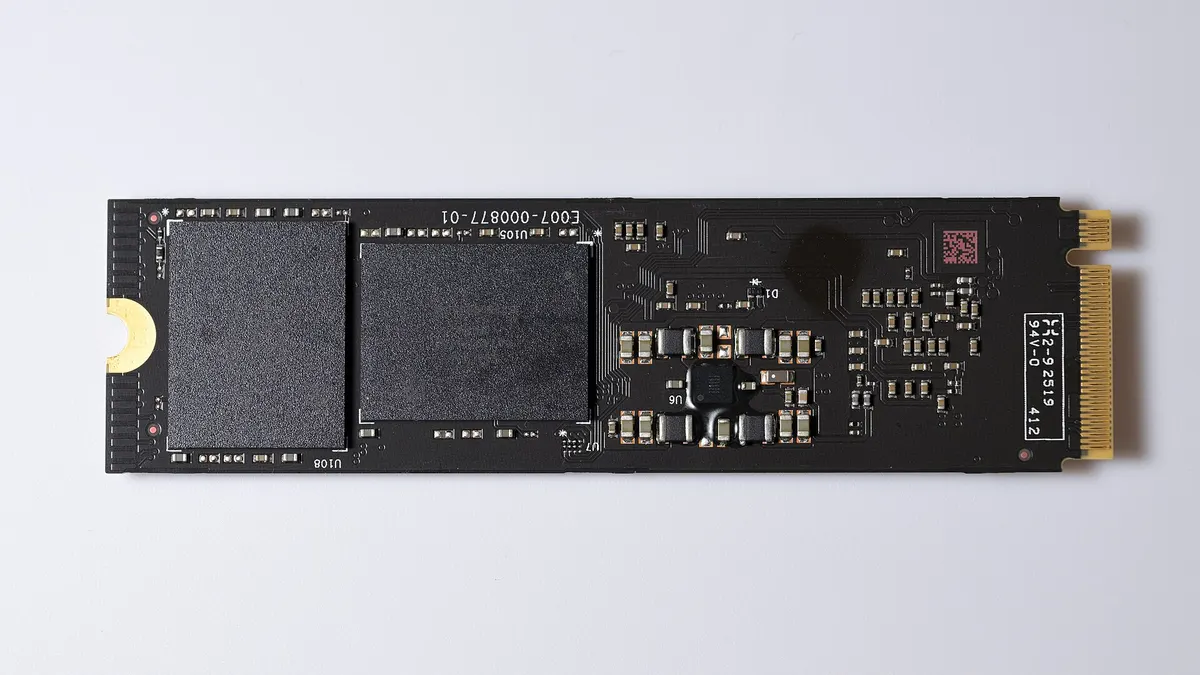
Phison has detailed two new enterprise solid-state drive designs at the Supercomputer 2026 conference. The designs aim to solve separate infrastructure problems for data centers.
One design features a built-in neural processing unit alongside 64GB of memory. This allows servers to run artificial intelligence frameworks directly on the storage hardware instead of moving massive datasets across the system.
What happened
Phison showcased two distinct enterprise storage architectures at the SC26 conference. The first is a computational-storage drive equipped with a built-in neural processing unit, or NPU, and 64GB of memory delivering 130 GB/s of bandwidth. This setup supports running artificial intelligence frameworks directly on the drive, including PyTorch, vLLM, OpenVINO, and llama.cpp. By processing data where it already resides, the server can offload tasks and send back only relevant results.
Phison stated that the integrated NPU provides 36,800 DMIPS of compute performance. This synthetic benchmark historically measures integer CPU performance rather than neural processing capabilities, though additional CPU cores likely handle general drive operations. The high-bandwidth memory allows the drive to handle demanding AI workloads locally, scanning and processing data in parallel. This approach could reduce transferred data volumes by 10 to 100 times for applicable workloads while freeing up the host central processing unit.
The second design merges a fast pseudo-SLC cache with large QLC flash capacity behind a single controller. Putting the cache inside each drive rather than relying on dedicated cache drives helps reduce overall system complexity, allowing every drive bay to contribute usable capacity.
Why it matters
Data centers running large artificial intelligence models face immense bottlenecks when transferring massive datasets between storage and host processors. By moving compute capabilities directly onto the storage drive, systems can drastically reduce data movement, save energy, and free up host processors for other tasks.
Phison's approach attempts to solve a major adoption hurdle by supporting common artificial intelligence frameworks without requiring specialized programming tools. Previous computational storage attempts often stumbled because developers had to write custom code for specific hardware accelerators. Allowing clients to utilize standard code written for common frameworks gives this architecture a distinct practical advantage.
The background
Phison's concept of putting compute on storage is part of a longer industry effort to overcome data transfer bottlenecks. Samsung previously introduced its SmartSSD in 2018, which integrated a field-programmable gate array onto the drive to process data locally. Samsung later refined that design in 2022, claiming significant reductions in processing time, energy consumption, and server CPU usage for database queries. However, that product line largely disappeared from Samsung's active offerings.
Other companies like ScaleFlux pursued narrower approaches, handling data compression directly inside the SSD controller so that the drive operates transparently like any standard NVMe storage device. Phison's new architecture builds upon these historical attempts by aiming for greater flexibility through standard framework compatibility.
What happens next
Phison has cautioned that many of the products and features mentioned during the Supercomputer 2026 conference are still in development. The company has not yet provided a firm release schedule for when these drives will be finalized and commercially available.
Several technical details also remain unconfirmed by the company. Phison did not disclose the exact type of memory used alongside the NPU, nor did it explain the specific mechanism the host system uses to communicate with and command the drive's onboard compute engine.
Key takeaways
- Phison detailed two new enterprise solid-state drive designs at the Supercomputer 2026 conference.
- One new drive features a built-in neural processing unit and 64GB of memory to support running artificial intelligence frameworks directly on the storage hardware.
- The computational storage design processes data where it resides, which could reduce transferred data volumes by up to 100 times for applicable workloads.
- A second drive design merges pseudo-SLC cache with QLC capacity behind a single controller to reduce system complexity.
- The company notes that many of the revealed products and features are still in development with no finalized release date announced.