
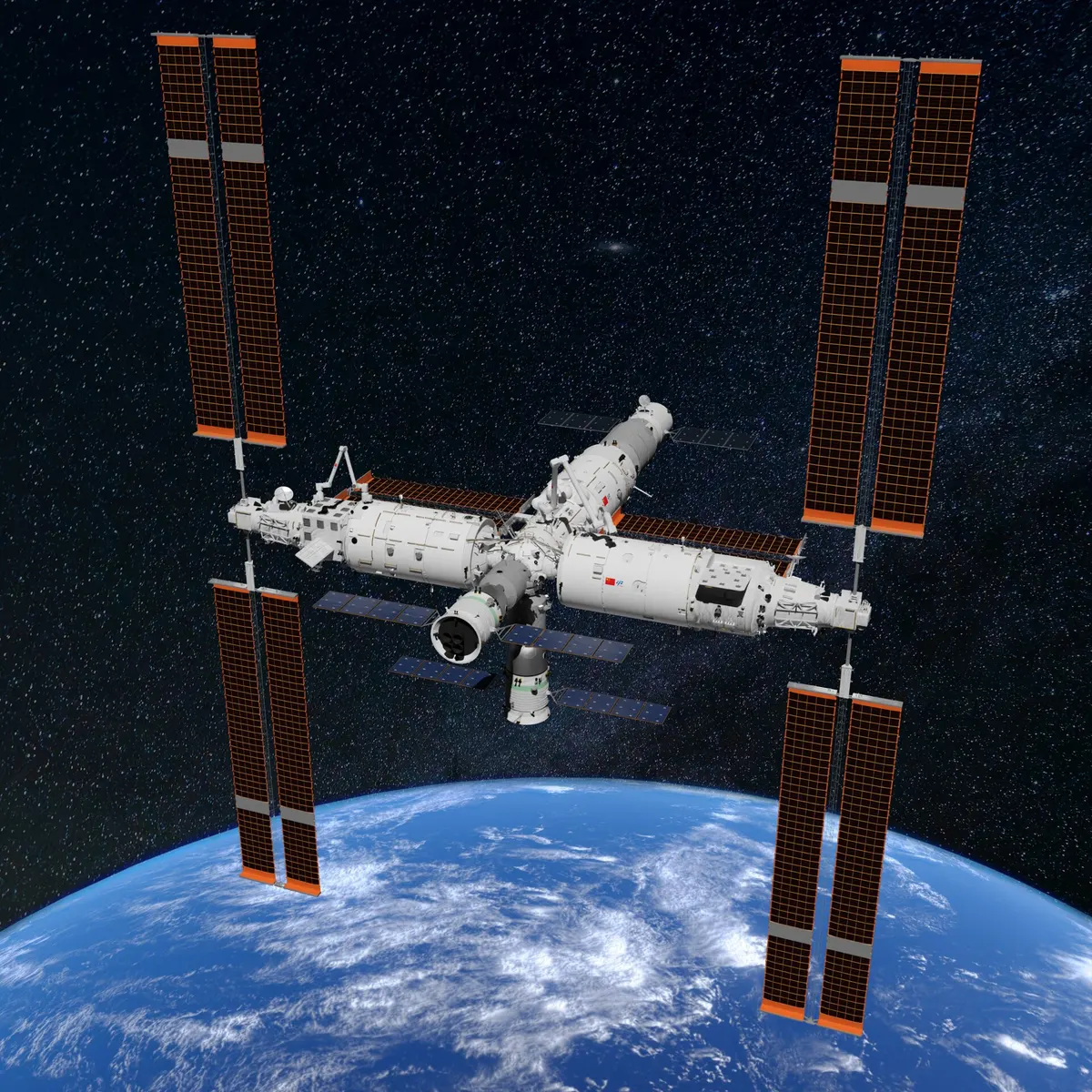
China launched its Shenzhou-24 space mission on Wednesday, sending three astronauts to the Tiangong space station from the Jiuquan Satellite Launch Center in the Gobi desert. The flight carried 40-year-on former Pakistan Air Force pilot Muhammad Zeeshan Ali, making him Pakistan's first astronaut and the first foreign national to join a Chinese crewed space mission.
The launch marks a major milestone for bilateral cooperation between Beijing and Islamabad. While in orbit, the international crew will conduct dozens of scientific experiments and technology tests before Ali returns to Earth after a short stay.
What happened
The Shenzhou-24 spacecraft blasted off aboard a Long March-2F rocket at 08:18 local time on Wednesday. Minutes after liftoff, the mission was declared a complete success as the craft successfully separated from its rocket and entered its predetermined orbit.
The three-member crew consists of mission commander Tang Hongbo, flight engineer Wu Yi, and payload specialist Muhammad Zeeshan Ali. Celebrations erupted across Pakistan following the launch, with citizens gathering in restaurants and watching television broadcasts of the event, while Prime Minister Shehbaz Sharif congratulated the nation on X.
During his time on the Tiangong space station, Ali will participate in approximately 90 scientific experiments and technology tests alongside his Chinese colleagues. His specific research duties include studying photosynthesis in bacteria, observing the effects of radiation and microgravity on seeds such as quinoa, and examining how the space environment impacts aging to help develop treatments for vascular diseases. Mastering the Chinese language was cited as one of Ali's primary challenges during his training.
Ali is expected to spend a short duration in space, ranging from five to ten days, before returning to Earth aboard the Shenzhou-23 spacecraft alongside returning crew members. Meanwhile, commanders Tang Hongbo and Wu Yi will remain at the orbital outpost for a six-month stint.
Why it matters
The mission carries significant diplomatic and symbolic weight for both nations. For Pakistan, which lacks its own domestic spacecraft capable of carrying humans into orbit, the flight represents a historic national achievement and an inspiration for the country's youth.
For Beijing, the flight serves as a crucial step in demonstrating that the Tiangong space station can function as an international research platform rather than an exclusive national facility. China has invested heavily in its space program and is actively working to establish itself as a prominent alternative to the United States-led space initiatives as it prepares for its planned lunar landing by 2030.
The background
China's Tiangong space station has been continuously operational since 2022, typically staffed by rotating crews of three astronauts who stay for approximately six months. The station represents the crown jewel of Beijing's ambitious aerospace endeavors.
Pakistan and China share a long history of cooperation, marking 75 years of collaboration in space this year. Under a bilateral space cooperation agreement signed in February 2025, Ali and fellow Pakistani astronaut candidate Khurram Dawood underwent intensive training in China under the supervision of Chinese experts before Ali was selected for the final flight.
What happens next
Ali is scheduled to complete his research activities aboard the station and return to Earth after a brief stay of five to ten days. Meanwhile, the remaining crew members will continue their extended missions, and officials from both nations have expressed hope that this flight will pave the way for deeper technological and aerospace cooperation in the future.
- Pakistan launched its first astronaut into space aboard China's Shenzhou-24 mission.
- Muhammad Zeeshan Ali became the first foreign national to visit the Tiangong space station.
- The crew will conduct roughly 90 scientific experiments, including research on photosynthetic microorganisms and quinoa seeds.
- China aims to position its space station as an international research platform ahead of its 2030 lunar landing goal.