
A hardware hacker known as BigCrimping, or Crimp, has developed a portable, open-source device called floppy3.5 designed to read and copy 3.5-inch floppy disks over a network or directly to an SD card. The tool makes it easy to archive vintage media without connecting an old drive to a modern computer. The project is aimed at retro computing enthusiasts and people looking to recover files from legacy digital cameras like the Sony Mavica series. Crimp has published all the necessary files on GitHub, allowing anyone to manufacture their own unit. ## What happened The floppy3.5 device is built around a custom printed circuit board, or PCB, featuring an RP2354A microcontroller and an ESP32-S3 bridge. To build a complete unit, makers also need to source a battery, a slimline floppy drive, a Wi-Fi module, and a microSD slot, alongside a 3D-printed enclosure using data provided by the creator. The hardware includes an onboard monochrome liquid crystal display, or LCD, which shows detailed diagnostics such as sector and cylinder counts, a map of good and bad sectors, file counts, and a progress counter for firmware updates. Physical buttons on the unit control basic functions. Pressing READ scans the files on an inserted disk, while SAVE dumps them directly to the microSD card. Power and display buttons manage the unit's power state and home screen. Users can insert multiple floppy disks sequentially to archive them onto the SD card without involving a computer. For network management, the device hosts a web interface accessible over Wi-Fi, while a direct USB cable connection provides advanced capabilities like retrieving full disk images. Instead of using a conventional floppy drive controller, the device relies on the Greaseweazle communications protocol. This protocol manages the drive's wire signals directly, reducing hardware requirements while granting full control over disk imaging and data manipulation regardless of format. The device supports the FAT12 file system by default, with further utilities available over the USB connection. ## Why it matters The project offers a practical solution for archiving aging magnetic media before physical degradation renders the data unrecoverable. Vintage digital cameras and early personal computers relied heavily on 3.5-inch floppies, leaving countless family photos and old documents stranded on obsolete formats. By combining network storage capabilities with a portable, battery-powered build, the device simplifies the tedious process of batch-processing hundreds of disks. Because the design is entirely open-source, enthusiasts do not have to rely on commercial availability or expensive legacy equipment to preserve their digital history. ## The background Floppy disks were once the universal standard for moving data between computers and storing files on personal systems. While 3.5-inch disks enclosed in rigid plastic shells outlived their flexible 5.25-inch predecessors, they eventually became obsolete due to the rise of compact discs, flash memory, and cloud storage. Despite this, a dedicated subculture of retro computing enthusiasts continues to maintain vintage hardware. Certain early digital cameras, most notably the Sony Mavica and Panasonic PV-SD families, achieved widespread popularity precisely because they recorded images directly onto standard PC-format floppy disks, leaving a lasting trail of physical media that contemporary computers can no longer read natively. ## What happens next With the project files and enclosure designs already published on GitHub, the next steps depend on the hardware hacking community to download, build, and test the units independently. The reports do not mention plans for commercial manufacturing, meaning enthusiasts must assemble the hardware themselves using Crimp's open-source specifications. ## Key takeaways - Hardware hacker BigCrimping built a portable, open-source Wi-Fi NAS device named floppy3.5 for reading 3.5-inch floppy disks. - The hardware requires a custom PCB with an RP2354A microcontroller, an ESP32-S3 bridge, a battery, a slimline floppy drive, and a microSD slot. - An onboard monochrome LCD shows sector maps, file counts, and diagnostics while physical buttons execute scans and data saves. - The device uses the Greaseweazle protocol to control drive signals directly, bypassing conventional floppy controllers to handle various disk formats.
Technology
Hardware hacker builds portable Wi-Fi NAS for 3.5-inch floppies
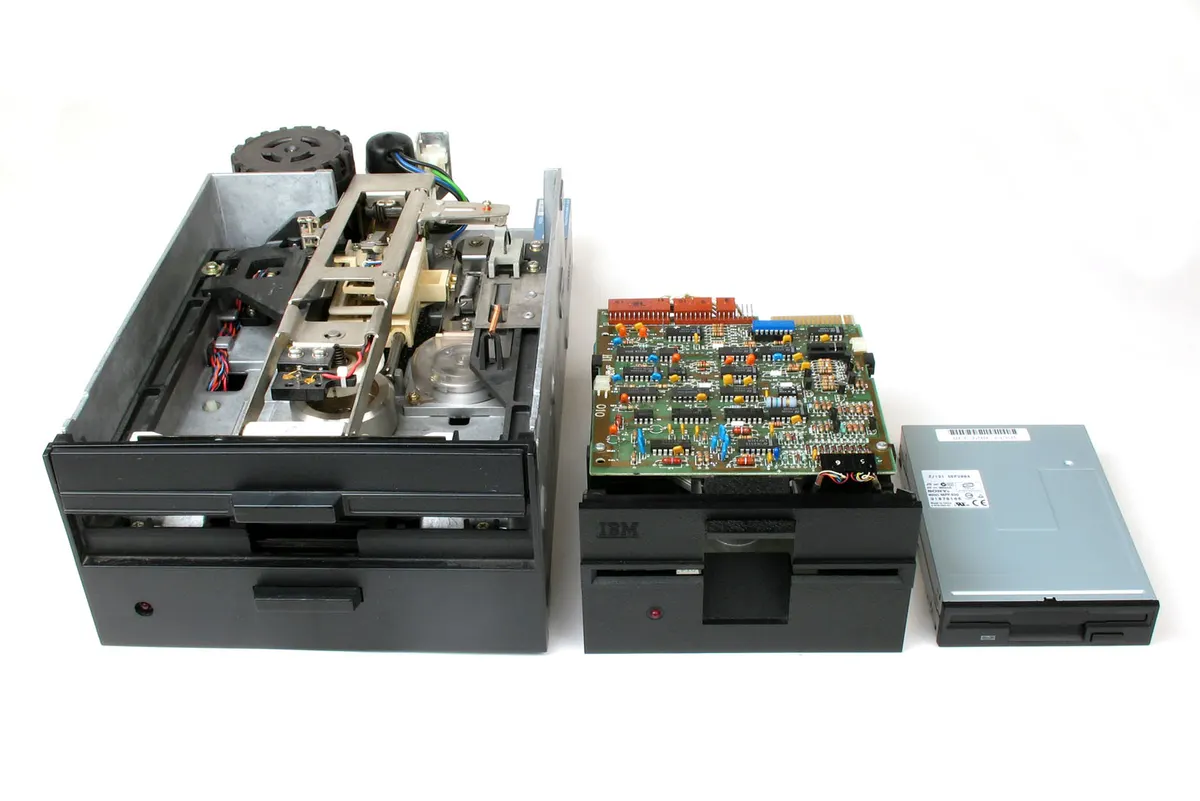
Photo: Swtpc6800 en:User:Swtpc6800 Michael Holley, Public domain / Wikimedia Commons
Hardware hacker BigCrimping has created a portable, open-source device that reads and archives 3.5-inch floppy disks over Wi-Fi or directly to an SD card without needing a computer.
Go deeper
Want more on this story? Our research assistant searches the latest reports across the web and explains what it finds, so you get the fuller picture in one place.