
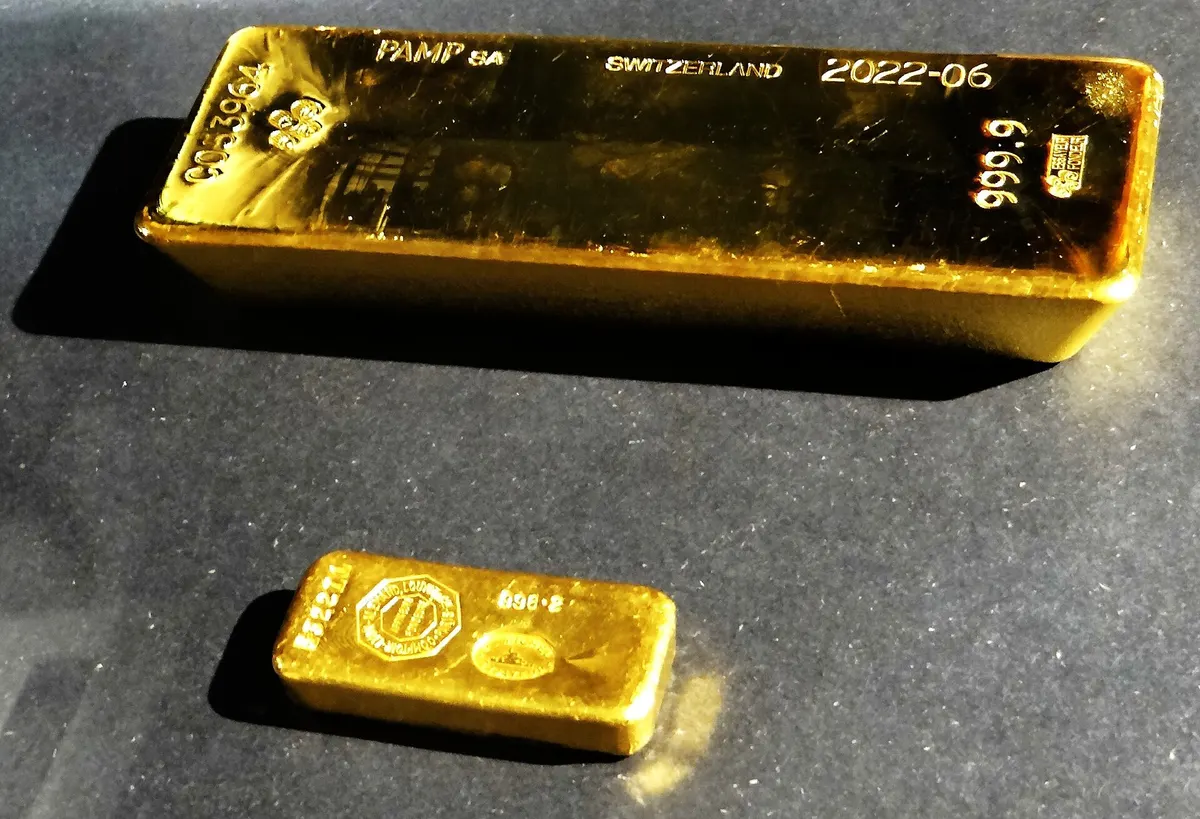
Gold prices experienced intense volatility, briefly plunging below the key $3,500 threshold before staging a sharp rebound. The precious metal fell to a 15-month low during a broader financial market selloff, only to recover as technology stocks stabilized and selling pressure eased. Despite this late-week bounce, market participants are grappling with a rapidly shifting monetary policy landscape driven by strong economic data out of the United States.
The core Personal Consumption Expenditures price index, which serves as the Federal Reserve's preferred gauge of underlying inflation, rose to 3.3% year-on-year in October. Headline inflation hit 3.8%, while separate data showed the US economy grew faster than initially estimated in the third quarter. These sticky inflation figures have solidified expectations that the US central bank will raise interest rates again at its upcoming December meeting, with additional tightening possibly slated for early 2027. This challenging backdrop is compounded by President Donald Trump unveiling a new round of tariffs targeting 14 major trading partners, including China, Japan, and the European Union.
What happened
Spot gold fell below the $3,500 mark on Wednesday for the first time since September 2025, driven down by heavy selling across financial markets. Investors facing severe liquidations in technology stocks and other risk assets were forced to raise cash, utilizing gold's high liquidity to cover margin calls and short positions ahead of a major US holiday.
By Friday, November 27, the downward spiral paused. Spot gold recovered significantly, rising 2.94% to reach $3,660.37 an ounce. Silver outperformed its yellow counterpart dramatically, surging 7.83% to $44.111 an ounce, while platinum and palladium also posted strong gains of roughly 5% during Asian trading hours. Asian equities advanced alongside the metals, supported in part by a rare midday statement from the Chinese State Council reassuring financial markets.
Why it matters
Precious metal investors and traders face heightened financial stakes as macroeconomic signals conflict with market liquidity needs. Higher interest rates increase the opportunity cost of holding non-yielding bullion, as government bonds and other interest-bearing assets become more attractive. When central banks tighten monetary policy to fight persistent inflation, non-yielding commodities like gold typically face severe downward pressure.
At the same time, industrial metals like silver are deeply tied to broader risk sentiment and manufacturing demand. The sharp swings in these markets directly impact retail buyers, institutional portfolios, and central banks that hold gold reserves as a hedge against systemic uncertainty.
The background
Gold is a precious metal traditionally viewed as a safe-haven asset during times of geopolitical conflict and economic turmoil. However, it does not pay interest or dividends, making its value highly sensitive to shifts in real interest rates and the strength of the US dollar. When borrowing costs rise, investors often shift capital toward yield-generating instruments.
The US Federal Reserve initiated a shift in monetary policy by delivering its first interest rate increase in three years this past September. Since then, stronger-than-expected economic growth and stubborn inflation metrics have forced Wall Street to price in a more aggressive path of monetary tightening than previously anticipated.
What happens next
Markets are closely monitoring the Federal Reserve's scheduled meeting for December 8 to 9, where a rate increase is widely expected. Investors are also attempting to gauge whether the central bank will introduce further tightening measures in early 2027.
Analysts remain divided on the long-term trajectory. Some market experts note that it is too early to declare a definitive price bottom for precious metals, warning that persistent real yields will limit bullion's recovery. Conversely, other long-term forecasts suggest gold could target higher valuations later in 2027 if market expectations eventually pivot toward monetary policy easing and safe-haven demand resurfaces.
Key takeaways
- Spot gold dropped below the key $3,500 mark before recovering sharply to trade above $3,660 an ounce.
- US core PCE inflation reached 3.3% in October, reinforcing expectations for a Federal Reserve rate hike in December.
- Silver significantly outperformed gold during the weekly recovery, surging over 7% due to its exposure to industrial demand.
- Higher interest rates continue to pose a major obstacle for gold by increasing the opportunity cost of holding non-yielding bullion.