
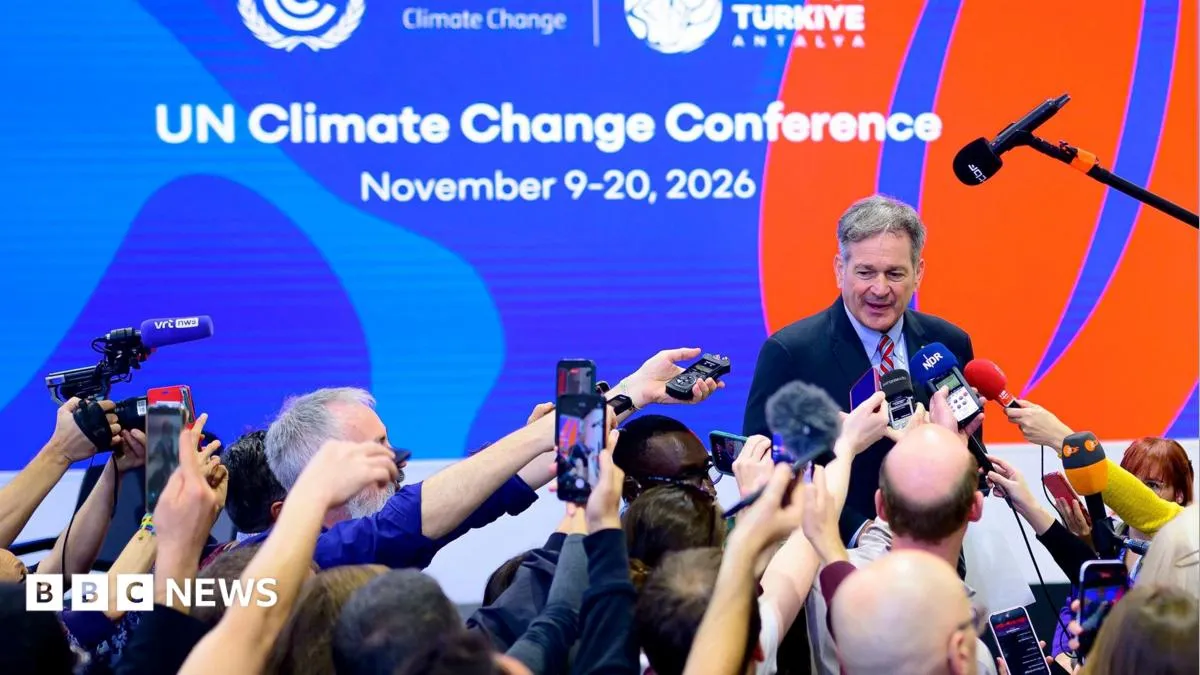
Negotiations at the COP31 United Nations climate summit in Turkey are deadlocked following a controversial late draft agreement that removed explicit references to reducing fossil fuel demand. A coalition of nations led by France and Panama pushed back against the text, arguing it is unacceptable for a global climate agreement to ignore the primary cause of global warming.
Simultaneously, developing nations, particularly the Africa Group, are demanding increased financial commitments for climate adaptation. With a final agreement expected soon, deep divisions remain over energy transitions, funding allocations, and the reality of missed global temperature targets.
What happened
The COP31 summit in Antalya ran past its scheduled closing time as nearly 200 nations struggled to resolve deep divisions over energy, science, and finance. Expectations for a major breakthrough had already been low due to an oil price shock and geopolitical tensions linked to the war in Iran. Mid-summit, COP31 President Murat Kurum was briefly interrupted by a protester shouting that leaders were killing the future.
The immediate crisis was triggered when a revised draft cover decision dropped explicit language regarding fossil fuels and removed a proposed adaptation funding target of $120 billion by 2035. The first draft had acknowledged the need to transition away from fossil fuels, while a pared-down second draft stripped those mentions entirely. Panama's environment minister, Juan Carlos Navarro, condemned the omission, stating that a cover decision without mention of fossil fuels is unacceptable. France's Minister of Ecological Transition, Monique Barbut, criticized references to carbon capture and storage as a loophole allowing countries to keep burning oil and gas. A group of European and developing countries released a letter insisting on a clear transition away from fossil fuels.
Meanwhile, the Africa Group fought for increased financial commitments, with Ghana's Environment Minister Zanetor Agyeman Rawlings declaring they did not come to the summit to beg. The earlier draft had highlighted that estimated adaptation needs will reach about $305 billion a year by 2035, compared to public adaptation finance of $28 billion to $32 billion in 2024. European officials countered that nations should use funds already pledged. Australia's Climate Minister Chris Bowen, leading negotiations, argued that the summit should focus on implementation and renewable energy growth, though some host nation actions by Turkey reportedly left delegations feeling disrespected.
Why it matters
The outcome of COP31 directly impacts global efforts to manage climate change and protect vulnerable populations. For the first time at a COP, the official agreement acknowledges that the goal of keeping global temperature rise below 1.5C has been missed, pushing the world into a dangerous period known as overshoot. Scientists warn that millions more people will face extreme heat and sea-level rise as a result.
Developing nations, particularly across Africa and in island states, bear the brunt of historical emissions from developed countries. The removal of specific financial targets for adaptation and loss and damage leaves these nations struggling to fund defenses against worsening climate disasters. At the same time, the inclusion or exclusion of fossil fuel phase-out language sets a vital global benchmark for whether governments will actively curb oil and gas consumption or allow emissions to continue under the guise of technological fixes.
The background
COP summits are annual UN climate conferences where countries negotiate global treaties to address climate change. Turkey hosted COP31, working alongside co-host Australia. These summits operate under the UN Framework Convention on Climate Change, aiming to limit global warming and coordinate financial and technical support for developing nations.
In recent years, tensions have consistently flared between fossil fuel-producing states and vulnerable developing nations over the pace of the green transition and who pays for it. The 2023 global stocktake established an agreement to transition away from fossil fuels in energy systems, a benchmark that negotiators at COP31 have struggled to reinforce or operationalize amid current energy supply disruptions and geopolitical conflicts.
What happens next
A new and potentially final agreement is expected to be published on Saturday. Negotiators, including Australia's Chris Bowen, have committed to working through the weekend to forge a compromise on energy and finance, though the ultimate text of the Antalya Accords remains unconfirmed.
Key takeaways
- Negotiations at the COP31 climate summit in Turkey stalled after a draft agreement dropped references to phasing out fossil fuels.
- France and Panama led a rebellion against the revised text, declaring it unacceptable to ignore the primary cause of global warming.
- Developing nations strongly criticized the removal of a proposed $120 billion adaptation funding target by 2035.
- The official agreement acknowledges for the first time that the goal of keeping global temperature rise below 1.5C has been missed.