
Chinese electric vehicle manufacturer Xpeng has introduced its latest general-purpose humanoid robot, named Iron, with plans to begin mass production in January. Brian Gu, the co-president of Xpeng, stated that the company could start deploying robots into home settings within one to two years after a successful commercial rollout. The announcement marks a significant expansion for the automaker into the competitive humanoid robotics sector, leveraging existing technologies developed for autonomous driving. Xpeng aims to tackle major technical hurdles by combining proprietary hardware, software, and real-world applications in a single package. ## What happened Xpeng revealed its Iron humanoid robot on Wednesday, detailing a timeline that begins with mass production in January. The company plans to deploy the robots as store assistants in its retail car locations during the first quarter of next year, followed by sales in the second quarter and customer deliveries later in the year. Xpeng's robotics unit raised $900 million at a $6.3 billion valuation in a summer funding round led by IDG Capital. Brian Gu explained that Xpeng's development stands out because it combines hardware, software, and real-life use cases. According to Gu, coordinating tasks simultaneously—such as walking while answering questions without getting distracted or falling down—represents the most challenging aspect of humanoid robotics. To control both its cars and humanoids, Xpeng announced its Turing Physical AI Architecture on Wednesday, utilizing artificial intelligence and real-time decision-making technology. Gu also noted that the robotics development relies on driver-assist chips the company already possesses, meaning U.S. restrictions on advanced semiconductor sales to China have not altered their supply chain. ## Why it matters The push into robotics offers Xpeng an avenue toward higher profit margins compared to the heavily contested Chinese electric vehicle market, where a severe downturn has weighed on the company. Gu stated that profitability for the robotics business could arrive as soon as next year, with the robotics division potentially becoming a meaningful part of Xpeng's overall business in two to three years. Investors, however, remain somewhat skeptical. Xpeng shares listed in New York and Hong Kong have dropped more than 55% this year amid broad sector declines. Furthermore, China's humanoid industry faces increased regulatory scrutiny regarding financing following a rush of capital into the sector and a high-profile initial public offering and subsequent stock slump by competitor Unitree. ## The background Founded in 2014 as an electric vehicle company, Xpeng has expanded beyond cars into artificial intelligence chips, personal flying vehicles, and robotics. The firm previously beat Tesla to rolling out driver-assist technology in mainland China. Xpeng's CEO and co-founder, He Xiaopeng, is a software engineer who initially believed software could solve every technical challenge before realizing the difficulties of building physical hardware safely and consistently. The industry at large is heavily populated by startups focusing on isolated components, such as artificial intelligence brains or mechanical hands, often relying on original equipment manufacturers to assemble the final product. ## What happens next Xpeng is scheduled to begin mass production of the Iron robot in January, with retail store trials slated for the first quarter of next year. Sales are set to begin in the second quarter, and deliveries are expected later in the year. While commercial deployment is imminent, household integration will require overcoming stringent safety requirements. Gu noted that homes demand higher battery power and performance consistency to operate safely around elderly people, children, pets, and emergency situations. Gu also expects Xpeng to attract additional investors following the planned commercial launch. ## Key takeaways - Chinese electric vehicle manufacturer Xpeng revealed its general-purpose humanoid robot, Iron, with mass production scheduled to begin in January. - Xpeng co-president Brian Gu stated that the company could start deploying robots into home settings within one to two years after commercial rollout. - The company's robotics unit raised $900 million at a $6.3 billion valuation in a summer funding round led by IDG Capital. - Xpeng shares listed in New York and Hong Kong have dropped more than 55% this year amid a downturn in the Chinese auto market.
Finance
Chinese EV Maker Xpeng Unveils Humanoid Robot for Retail and Homes
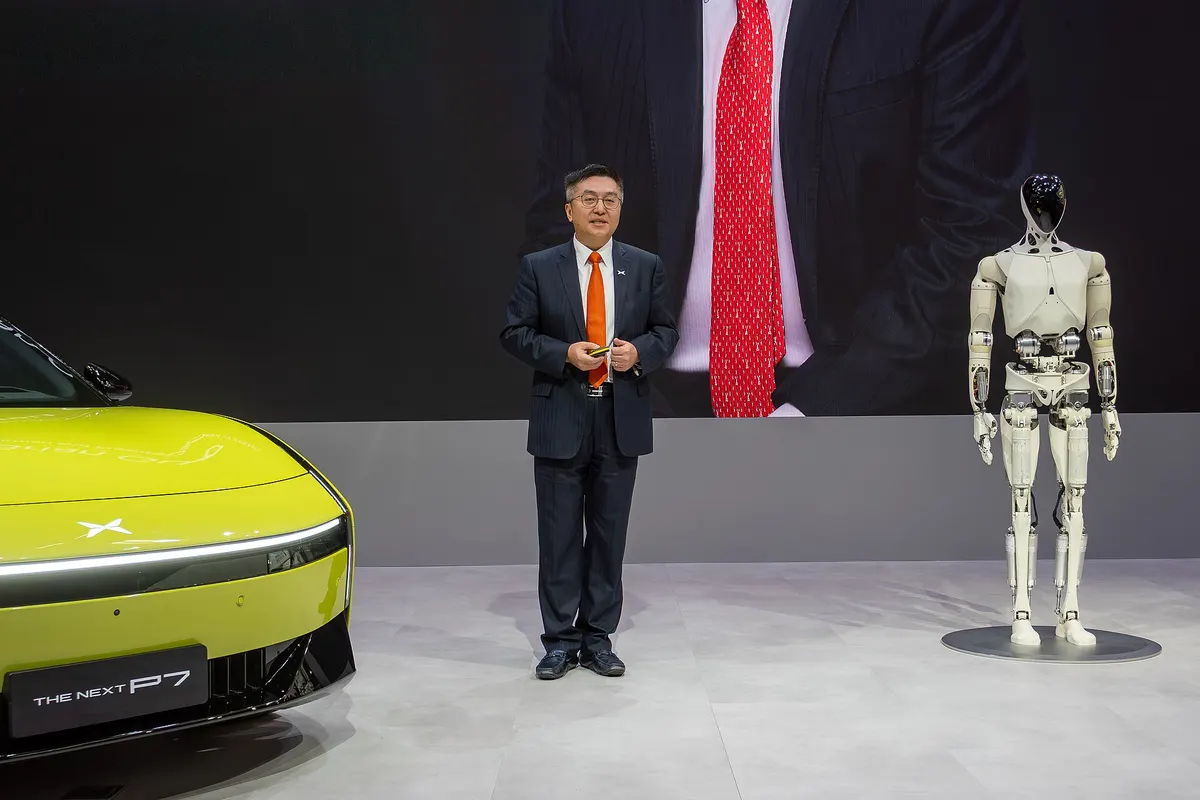
Photo: Matti Blume, CC BY-SA 4.0 / Wikimedia Commons
Chinese electric vehicle maker Xpeng has revealed its new humanoid robot, Iron, aiming to deploy the machines in commercial settings soon and in households within two years.
Go deeper
Want more on this story? Our research assistant searches the latest reports across the web and explains what it finds, so you get the fuller picture in one place.