
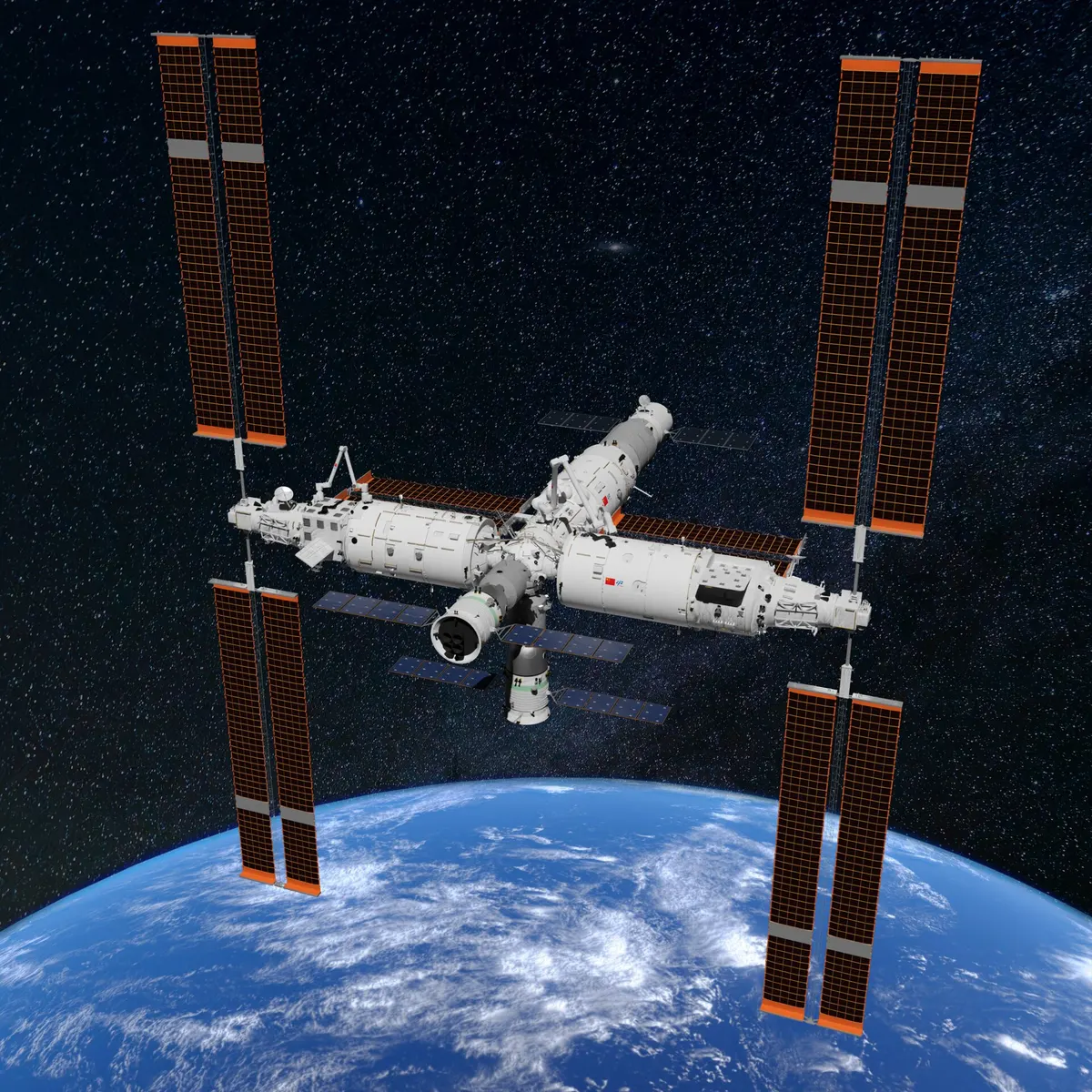
China successfully launched the Shenzhou-24 crewed spacecraft from the Gobi Desert, carrying Pakistan's first astronaut into orbit. The mission docked at the Tiangong space station just three and a half hours after liftoff.
The flight marks a major milestone for bilateral ties and establishes the Tiangong station as an international research platform. Muhammad Zeeshan Ali is joined by Chinese commander Tang Hongbo and flight engineer Wu Yi.
What happened
The Shenzhou-24 mission lifted off at 08:18 local time from the Jiuquan Satellite Launch Center in northwest China aboard a Long March-2F carrier rocket. Approximately ten minutes later, the spacecraft separated from the rocket and entered its predetermined orbit, prompting the China Manned Space Agency to declare the launch a complete success. The spacecraft docked with the forward port of the Tianhe core module at the Tiangong space station roughly three and a half hours after launch.
The three-member crew consists of mission commander and spacecraft pilot Tang Hongbo, flight engineer Wu Yi, and payload specialist Muhammad Zeeshan Ali. Ali, a 40-year-old former Pakistan Air Force pilot, is the first foreign astronaut to visit China's orbital laboratory and the first Pakistani in space. To prepare for the mission, Ali underwent seven months of intensive training in Beijing, which included learning the Chinese language, reading poetry, practicing calligraphy, and studying under Chinese space experts.
During his time on board, Ali is scheduled to stay for a short period of five to ten days before returning to Earth alongside departing crew members. His scientific work will include four collaborative projects between China and Pakistan in biotechnology and materials science. These include investigating photosynthetic cyanobacteria for potential oxygen regeneration in deep-space missions, exposing quinoa seed samples to space radiation and microgravity, and testing solar-heated self-healing carbon-fiber composites and graphene-based hybrid composites. Meanwhile, Chinese astronauts Tang and Wu will remain at the station for a standard six-month rotation alongside Zhu Yangzhu, who is staying behind for a year-long record-setting stay to study long-term human adaptation to space.
Why it matters
The mission carries significant diplomatic weight for Beijing, which has poured billions of dollars into its space programme. China is keen to showcase Tiangong as an open international research hub as the aging International Space Station faces potential retirement by 2030, positioning itself as a major alternative to US-led space efforts ahead of a planned crewed lunar landing by 2030.
For Pakistan, which lacks its own spacecraft to send astronauts into orbit, securing a spot on the flight represents a massive triumph for national prestige and technological ambition. Pakistani leaders hailed the event as a testament to the ironclad friendship between the two nations, opening doors for developing countries to access critical space capabilities and paving the way for potential future joint lunar missions.
The background
Space cooperation between China and Pakistan has a long history dating back to the early 1990s, during which China has launched multiple Pakistani satellites. The Tiangong space station, whose name translates to Celestial Palace, has been fully operational since late 2022 and is normally stewarded by rotating three-person crews. China operates independently in space after being barred from the International Space Station due to US legislation over security concerns.
What happens next
Following his brief stay at the orbiting laboratory, Muhammad Zeeshan Ali will return to Earth with the departing members of the previous crew rotation. Meanwhile, the extended crew aboard Tiangong will continue conducting over 90 scientific experiments and technology tests, including studies on vascular aging and advanced space medicine, while preparing for China's broader ambitions to reach the moon.
- China successfully launched the Shenzhou-24 spacecraft carrying Pakistan's first astronaut, Muhammad Zeeshan Ali, to the Tiangong space station.
- Ali trained in Beijing for seven months, mastering the Chinese language and participating in bilateral research on biotechnology and materials science.
- The mission serves as a diplomatic milestone for Beijing as it seeks to promote Tiangong as an international research platform alongside its 2030 lunar ambitions.