
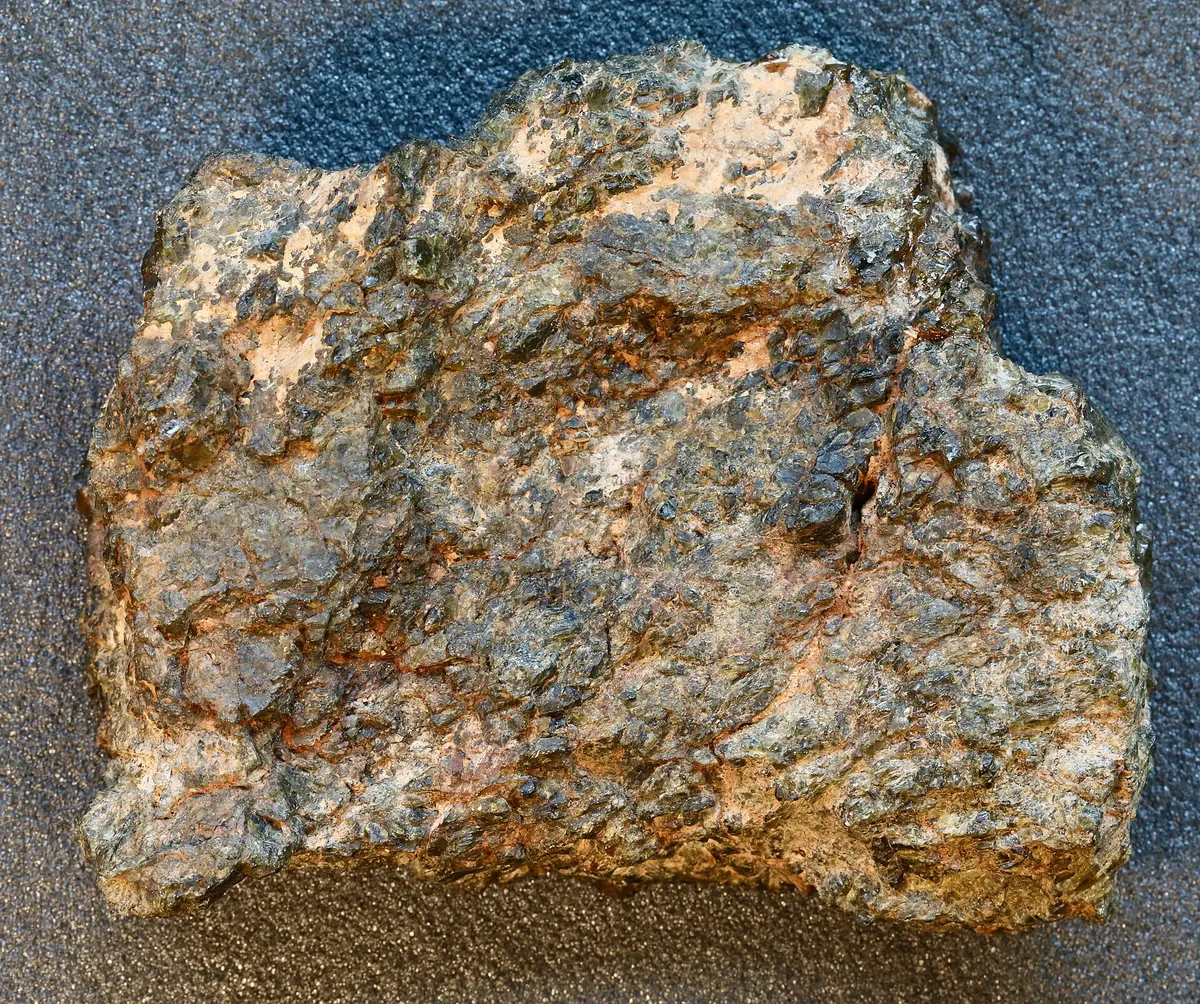
In 2015, a prospector named David Hole was searching for gold in Maryborough Regional Park in central Victoria, Australia. Armed with a metal detector, he uncovered a heavy, reddish rock resting in yellow clay and took it home, convinced it contained a gold nugget.
Despite using a rock saw, an angle grinder, a drill, acid, and a sledgehammer, Hole could not make a single crack in the stubborn object. Years later, he brought the mysterious specimen to the Melbourne Museum, where geologists identified it not as gold, but as a rare and exceptionally heavy meteorite.
What happened
Hole had been exploring the Victorian Goldfields region, where a massive gold rush peaked during the 19th century. Unable to break his find open, he eventually handed the specimen over to the Melbourne Museum for professional identification. Geologists Dermot Henry and Bill Birch examined the rock and immediately suspected an extraterrestrial origin due to its unusual density and sculpted exterior.
The museum geologists used a diamond saw to slice off a small section of the rock for analysis. Their findings were published in July 2019 in the Proceedings of the Royal Society of Victoria, alongside geologist Andrew Tomkins. The scientific team officially named the specimen the Maryborough meteorite, after the nearby town where it was unearthed.
The meteorite measures roughly 15.4 inches long, 5.5 inches wide, and 5.5 inches thick, weighing a massive 17 kilograms or 37.5 pounds. Laboratory tests classified it as an H5 ordinary chondrite, meaning it possesses a high iron content and contains tiny crystallized silicate droplets known as chondrules. Carbon-14 dating indicates the space rock landed on Earth less than 1,000 years ago, though researchers have found no impact crater associated with its arrival.
Why it matters
For researchers, finding a pristine meteorite holds scientific value that far eclipses a normal gold discovery. Scientists use these objects as a low-cost form of space exploration to study the chemical composition, age, and formation of our Solar System, including Earth itself. The Maryborough meteorite represents only the 17th meteorite ever recorded in the state of Victoria, the third H5 chondrite found there, and the second-largest single chondritic mass discovered in the state.
The background
Ordinary chondrites like Maryborough generally originate in the vast asteroid belt situated between Mars and Jupiter. Scientists believe that asteroid collisions in deep space nudge these rocks out of orbit, eventually sending them on a trajectory toward Earth. The Maryborough specimen dates back approximately 4.6 billion years, making it slightly older than Earth and matching the turbulent period when the Solar System first formed from clouds of dust and rock.
What happens next
Researchers have not yet determined the exact parent body in space where the meteorite originated, nor is it known precisely how long it drifted through the cosmos before striking Earth. Local historical newspapers documented multiple meteor sightings across the region between 1889 and 1951, but scientists have not been able to link the rock to any specific historical event.
Key takeaways
- David Hole spent years trying to crack open a heavy rock with tools like an angle grinder and a sledgehammer, believing it held gold.
- Geologists at the Melbourne Museum identified the stubborn object as a rare 17-kilogram meteorite dating back 4.6 billion years.
- The object was officially classified as an H5 ordinary chondrite with high iron content and small silicate chondrules.
- Carbon-14 dating suggests the meteorite landed on Earth less than a thousand years ago, making it the 17th recorded meteorite in Victoria.