
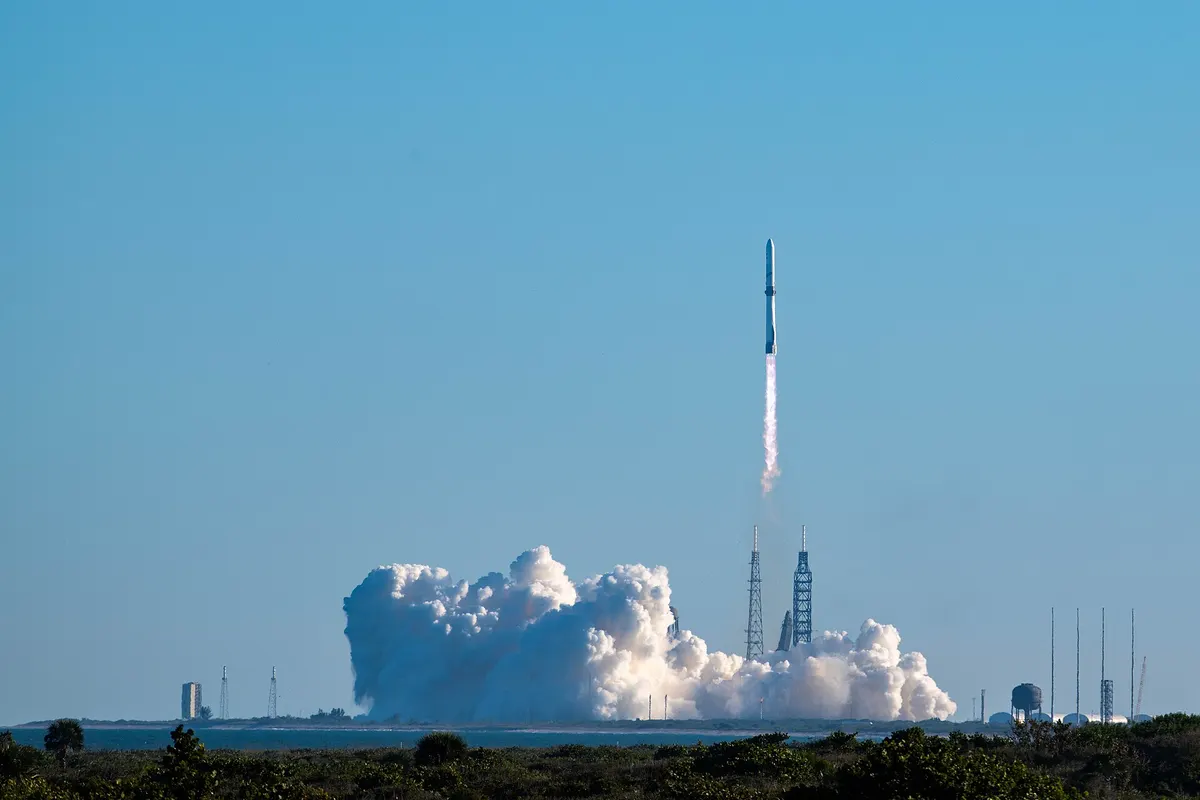
Google is teaming up with aerospace company Blue Origin to launch artificial intelligence server satellites into orbit. The partnership, announced on Thursday, will utilize Blue Origin's New Glenn rocket to shuttle the hardware into space during the first quarter of 2029.
The mission forms a central part of Project Suncatcher, which is Google's ambitious plan to eventually place AI data centers in space. While Google previously deployed an AI server satellite in October using a SpaceX Falcon 9 rideshare launch, the upcoming flight with Blue Origin represents the first dedicated heavy-lift launch for the project.
What happened
The agreement pairs Google with Blue Origin, the aerospace company founded by Jeff Bezos. The companies confirmed that the New Glenn rocket will carry satellites equipped with Google's custom Tensor Processing Units, known as TPUs, into a sun-synchronous orbit in early 2029. Google's earlier October test successfully booted up these custom AI chips in orbit and used an on-board AI model called Gemma 4 to beam an artificial intelligence-generated haiku back down to Earth. This new upcoming flight will scale up operations significantly by deploying satellites that pack computing capacity roughly comparable to a terrestrial data center rack.
What to know
Project Suncatcher is an experimental initiative exploring the viability of moving heavy computing workloads off Earth. Data centers on the ground require vast amounts of electrical power and cooling infrastructure, presenting challenges for energy grids. Shifting data centers to orbit opens up the possibility of utilizing continuous solar power in space, though it introduces entirely new technical hurdles regarding hardware durability, radiation protection, and data transmission back to Earth.
Why it matters
The collaboration signals a serious push by major tech companies to look beyond terrestrial infrastructure for powering the next generation of artificial intelligence workloads. By securing a dedicated heavy-lift launch from an established provider like Blue Origin, Google is moving past small-scale testing toward infrastructure capable of supporting substantial computational demands in orbit.
Key takeaways
- Blue Origin will launch Google AI server satellites in the first quarter of 2029 using its New Glenn rocket.
- The mission is the first dedicated heavy-lift launch for Project Suncatcher, Google's initiative to place data centers in space.
- Satellites on this flight will feature computing capacity roughly at the scale of a data center rack.
- Google previously tested an AI server satellite in October, successfully running TPUs and transmitting an AI-generated haiku using the Gemma 4 model.