
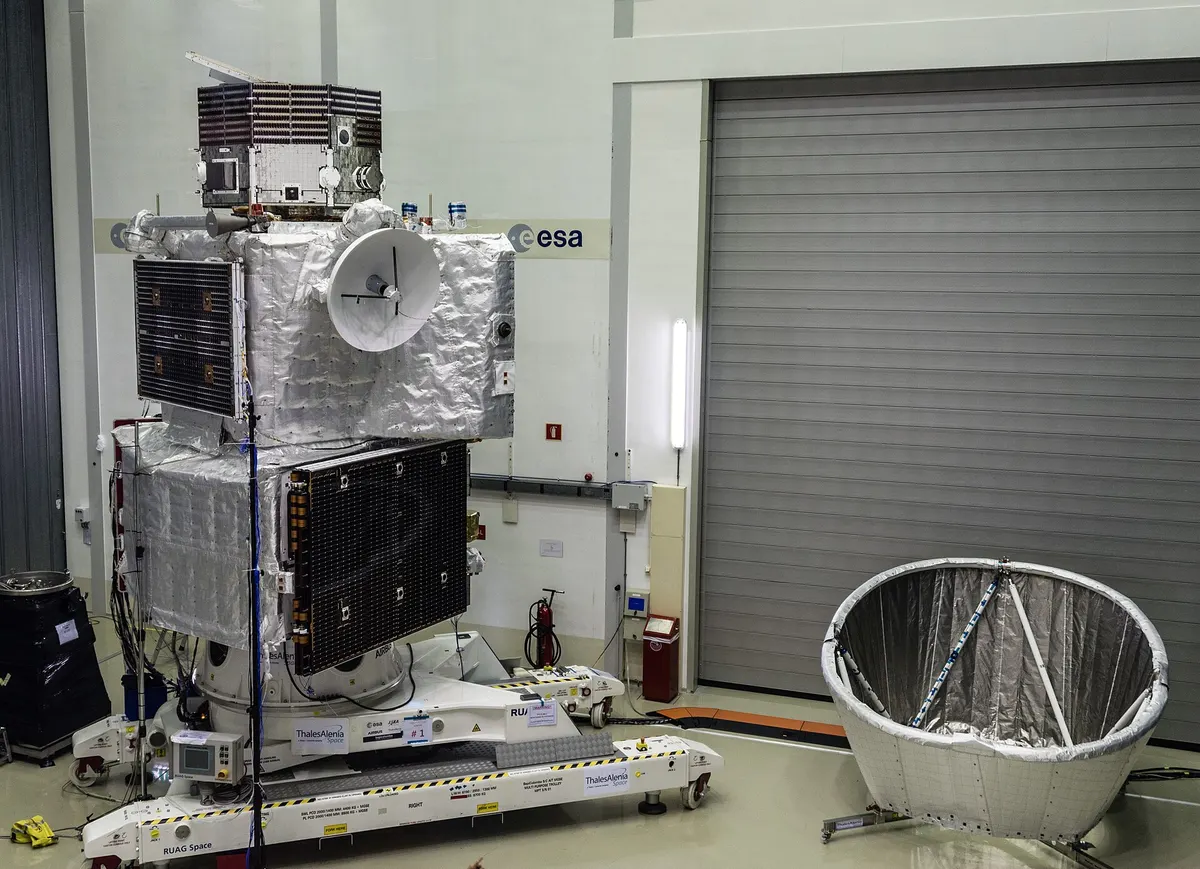
After an eight-year journey spanning nearly six billion miles, the BepiColombo spacecraft has successfully arrived at its destination and entered orbit around Mercury. The joint mission by the European Space Agency and the Japanese Space Agency aims to uncover long-standing secrets of the inner Solar System's least-explored rocky planet.
Operating in an exceptionally harsh environment, the probe faces extreme temperatures ranging from 430C to -180C alongside intense solar radiation. Researchers hope the mission will finally explain phenomena such as ice locked inside polar craters and the unusual hollows dotting the planetary surface.
What happened
The BepiColombo mission launched from French Guiana in 2018. Because the spacecraft was heading deep into the inner Solar System, it had to constantly battle the immense gravitational pull of the Sun. To slow down enough to enter orbit, the probe took a convoluted path that involved looping once around the Earth, twice around Venus, and six times around Mercury.
A propulsion system problem extended the planned seven-year voyage by an extra year. The final orbital insertion required a perilous 37-minute manoeuvre that allowed the craft to be captured by the planet's gravity. The European Space Agency confirmed via telemetry data on X that the probe is now flying safely around the planet.
Why it matters
Mercury remains largely a mystery despite being a rocky neighbor in our solar system. The planet is only slightly larger than Earth's Moon, yet it possesses a disproportionately massive metal core. Scientists believe this unusual composition could be the result of a catastrophic ancient collision that stripped away the planet's original outer mantle and crust.
Understanding Mercury helps scientists learn more about how rocky planets form and evolve. Researchers also want to understand how the planet interacts with the Sun and severe space weather, which could shed light on planetary formation across the wider universe.
The background
Until now, only two NASA missions have ever visited Mercury. Mariner-10 flew past the planet three times during the 1970s, and the Messenger spacecraft entered orbit in 2011, spending four years studying the tiny world. Mercury experiences extreme time dynamics: its year lasts just 88 Earth days, while a single day on its slow-turning axis takes 59 Earth days.
Scientists have been particularly puzzled by thousands of shallow, steep-sided hollows discovered across the surface. These geological features are remarkably young, roughly 100,000 years old, and are distinct from traditional impact craters caused by colliding space rocks.
What happens next
Over the coming weeks, the BepiColombo mission will transition into its next phase when its two component spacecraft separate. An ESA craft will study the planetary surface up close, while a JAXA craft will observe the planet and its space environment from a distance.
Researchers expect the mission to clarify the origins of the polar ice and resolve debates over whether Mercury's massive core formed through multiple impacts or simply developed in a metal-rich region of the early Solar System.
Key takeaways
- The BepiColombo spacecraft has entered orbit around Mercury after an epic eight-year voyage traveling nearly six billion miles.
- The mission is a collaborative effort between the European Space Agency and the Japanese Space Agency.
- Researchers hope to solve major mysteries, including why ice exists in craters despite intense heat and the origin of mysterious surface hollows.
- The spacecraft had to brake continuously and take a complex path looping around Earth, Venus, and Mercury to counteract the Sun's gravity.