
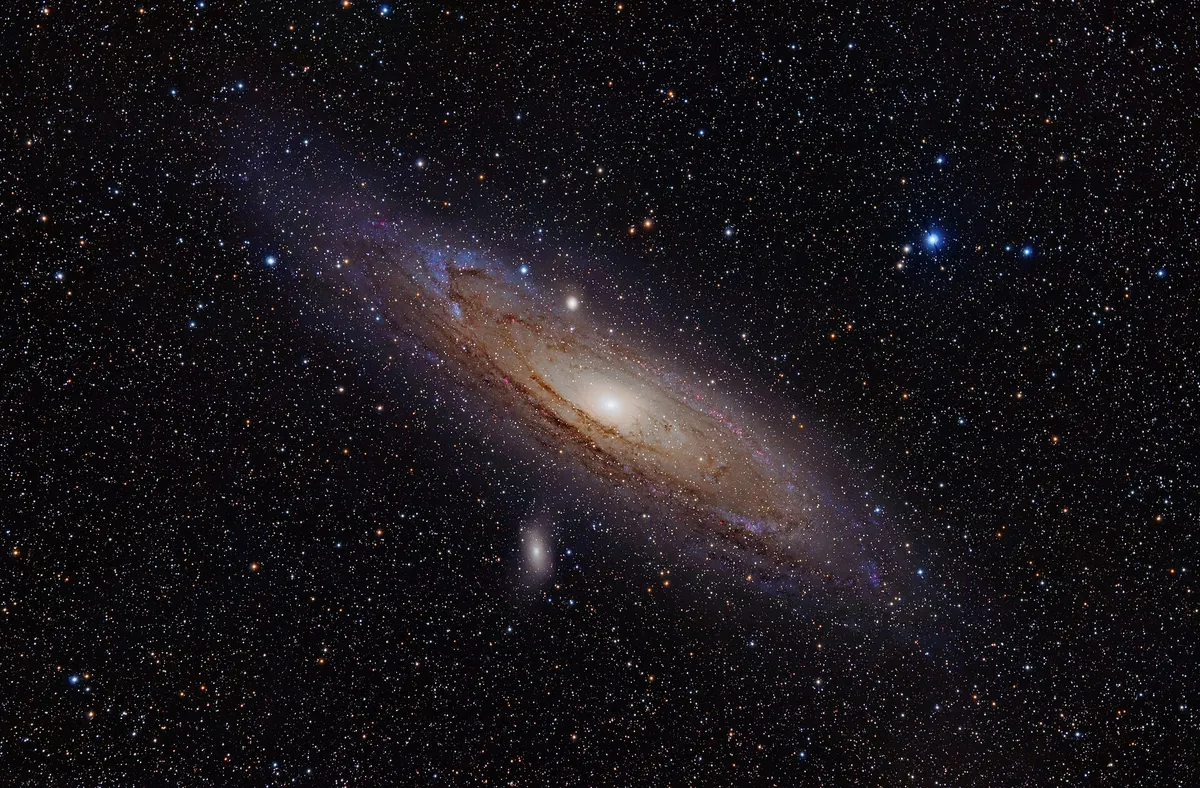
Astronomers have witnessed a giant star in the Andromeda Galaxy spend nearly a decade slowly swallowing its smaller companion before erupting in a luminous red nova. Led by Columbia University astrophysicist Viraj Karambelkar, researchers used data from about a dozen telescopes and surveys to track the entire spectacle from the decades before it began to the final explosion in late 2025.
This marks the first time scientists have caught the process of common envelope evolution in the act, confirming a theory proposed in the 1970s. The discovery provides crucial evidence for how some of the tightest pairs of stars in the universe form and evolve.
What happened
The event unfolded in a system named AT 2025abao in the Andromeda Galaxy. Using photographic sky plates going back to 1989 alongside modern facilities like the Wide-field Infrared Transient Explorer (WINTER) telescope at Palomar Observatory and NASA's NEOWISE mission, researchers reconstructed the history of the system. Until 2018, the primary star was a quiet giant late in its life, about 350 times wider than the Sun, while its smaller companion remained completely hidden because the giant outshined it by a factor of about 18,000. Based on dust shed prior to the engulfment, scientists estimated the smaller companion was a star of roughly 0.7 solar masses.
Between 2018 and early 2025, the giant brightened two- to threefold in visible light and swelled while maintaining a nearly constant temperature. The smaller companion was skimming through the giant's outer layers, losing orbital energy to friction and heating up the surrounding gas envelope in a process compared to a spacecraft reentering Earth's atmosphere. In July 2025, NASA's SPHEREx space telescope revealed that the giant had grown to roughly 860 times the Sun's width and wrapped itself in fresh dust as its visible light briefly dropped by half while its infrared glow kept rising.
In October 2025, the star brightened roughly 100-fold in just 25 days, shining like 1.5 million Suns at its peak. The companion's orbit decayed rapidly, causing it to fall deep inside the stellar envelope and crash into the core. That violent collision triggered an internal explosion that ejected material and produced all the hallmarks of a luminous red nova.
Why it matters
For decades, common envelope evolution remained an unproven hypothesis used to explain how binary stars end up orbiting extremely close to one another. Capturing this event in real time gives astrophysicists empirical proof of how stellar orbits shrink and how stellar mergers release gravitational energy. It bridges a major observational gap in understanding the life cycles of binary star systems.
The background
Common envelope evolution was proposed in the 1970s as a theoretical explanation for the formation of tight binary star systems. When one star in a pair grows old, it expands into a giant, eventually engulfing its companion. The two stars temporarily share a single, loosely bound envelope of gas. As the inner star drags through this material, friction causes it to spiral inward, leading either to a much tighter orbit or a complete merger.
What happens next
The reports do not detail future observation schedules for this specific system, though researchers continue to analyze the wealth of multi-telescope data gathered during the multi-year event to better understand the mechanics of stellar engulfment and luminous red novae.
Key takeaways
- Astronomers witnessed a giant star in the Andromeda Galaxy slowly swallow its smaller companion over nearly a decade.
- The discovery provides the first direct observation of common envelope evolution, a theory first proposed in the 1970s.
- In October 2025, the engulfed companion crashed into the stellar core, triggering an explosion that brightened the star roughly 100-fold in 25 days.
- The resulting outburst displayed all the classic characteristics of a luminous red nova caused by merging stars.