
Diesel Tanker Capsizes Off Ibiza Coast, Leaving One Crew Member Dead
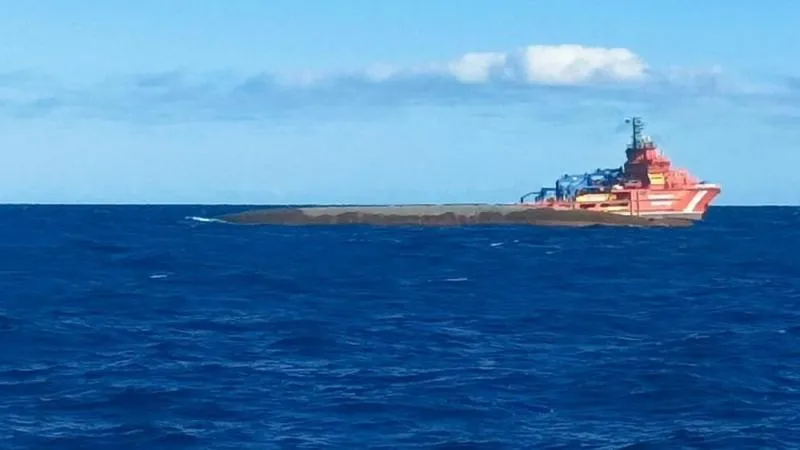
The Malta-flagged tanker Med Emre sits partially submerged in the Balearic Sea off the coast of Ibiza.
A Malta-flagged chemical tanker carrying up to 7,000 tonnes of diesel has capsized in the Mediterranean Sea off the coast of Ibiza, Spain. All 17 crew members were rescued, but one later died in hospital following the incident. Authorities have deployed pollution control vessels to monitor the partially submerged wreck, while initial reports indicate any localized fuel slick has dissipated.
- Location25 nautical miles off Ibiza, Spain
- VesselMed Emre (Malta-flagged chemical tanker)
- CargoUp to 7,000 tonnes of diesel
- Casualties1 crew member dead, 7 hospitalized
- StatusVessel partially submerged, situation stabilized
Photos
7 photosWhat happened
A Malta-flagged chemical tanker named the Med Emre capsized in the Mediterranean Sea while traveling from Algeciras in southern Spain to Barcelona in the north-east. The vessel was carrying up to 7,000 tonnes of diesel fuel when it encountered trouble off the coast of the Spanish island of Ibiza.
While initial reports suggested the ship had completely gone under, regional emergency officials clarified that the tanker remains partially submerged at a 90-degree angle. Authorities have mobilized an airplane and Spain's national maritime rescue service pollution control vessel, the Clara Campoamor, to evaluate potential environmental fallout.
How it unfolded
Rescuers in the coastal Spanish city of Valencia received an initial distress call from the vessel at approximately 22:30 local time on Wednesday. Moments after the distress signal, the crew reported a leak on board and stated that the ship was tilting dangerously at a 90-degree angle.
Emergency services launched a rescue operation, successfully recovering all 17 crew members from the stricken vessel. Although a small fuel slick initially formed in the surrounding waters, maritime officials confirmed that the slick had quickly dissipated and described the overall situation as stabilized.
The people involved
The Med Emre carried a total crew of 17 people, all of whom were rescued from the water following the capsizing. Following their rescue, seven crew members were transported to medical facilities for treatment.
Six of the hospitalized individuals suffered minor injuries, including hypothermia, according to Spanish media reports. Tragically, one of the rescued crew members was later pronounced dead at the hospital, as confirmed by Balearic Islands emergency services.
Why it matters
The incident poses an immediate ecological concern due to the proximity of Ibiza's sensitive marine environment, which was designated a Unesco World Heritage List site in 1999. The local waters contain dense prairies of Posidonia oceanica seagrass—a unique marine plant found exclusively in the Mediterranean basin that plays a critical role in supporting regional biodiversity.
Any significant fuel spill could inflict severe, long-lasting damage on these delicate underwater ecosystems and local coastal economies. The rapid deployment of pollution control assets highlights the high stakes involved in preventing environmental contamination in the region.
The background
Spain carries a heavy historical sensitivity toward maritime oil spills due to past catastrophes. Most notably, in 2002, the country suffered one of its worst environmental disasters when the Prestige oil tanker ran into trouble off the coastline of Galicia, spilling more than 60,000 tonnes of heavy fuel oil into the sea.
Because of such historical precedents, Spanish maritime authorities maintain strict monitoring protocols and specialized response vessels, such as the Clara Campoamor, to intercept and contain potential spills before they reach fragile coastal habitats.
Response and aftermath
Emergency response teams acted swiftly upon receiving the Wednesday night distress call, rescuing all 17 crew members and coordinating emergency medical care across hospitals in Valencia and the Can Misses Hospital in Ibiza. Balearic Islands President Marga Prohens and Valencia maritime captain Elena Delgado have both coordinated public updates regarding the rescue and containment efforts.
Aerial and marine monitoring units continue to survey the area surrounding the partially submerged tanker. Officials have stated that comprehensive structural inspections of the wreck are scheduled to take place.
What happens next
Maritime authorities are scheduled to conduct thorough safety and environmental inspections around the wreck. These evaluations will determine the structural integrity of the partially submerged Med Emre and check for any latent risks of fuel leakage from its cargo holds.
Depending on the outcome of Thursday and Friday inspections, salvage experts will plan the safe removal or stabilization of the vessel and its remaining diesel cargo to prevent any long-term ecological threat to the Balearic Sea.
What we still don't know
The exact catalyst behind the capsizing remains entirely unclear, as official investigations have not yet determined what caused the tanker to list at a 90-degree angle and leak.
Furthermore, specific details regarding the identity of the deceased crew member, the precise nationalities of the crew, and the overarching timeline for salvaging the remaining diesel fuel have not been publicly reported.
Want more on this story? Our research assistant searches the latest reports across the web and explains what it finds, so you get the fuller picture in one place.