
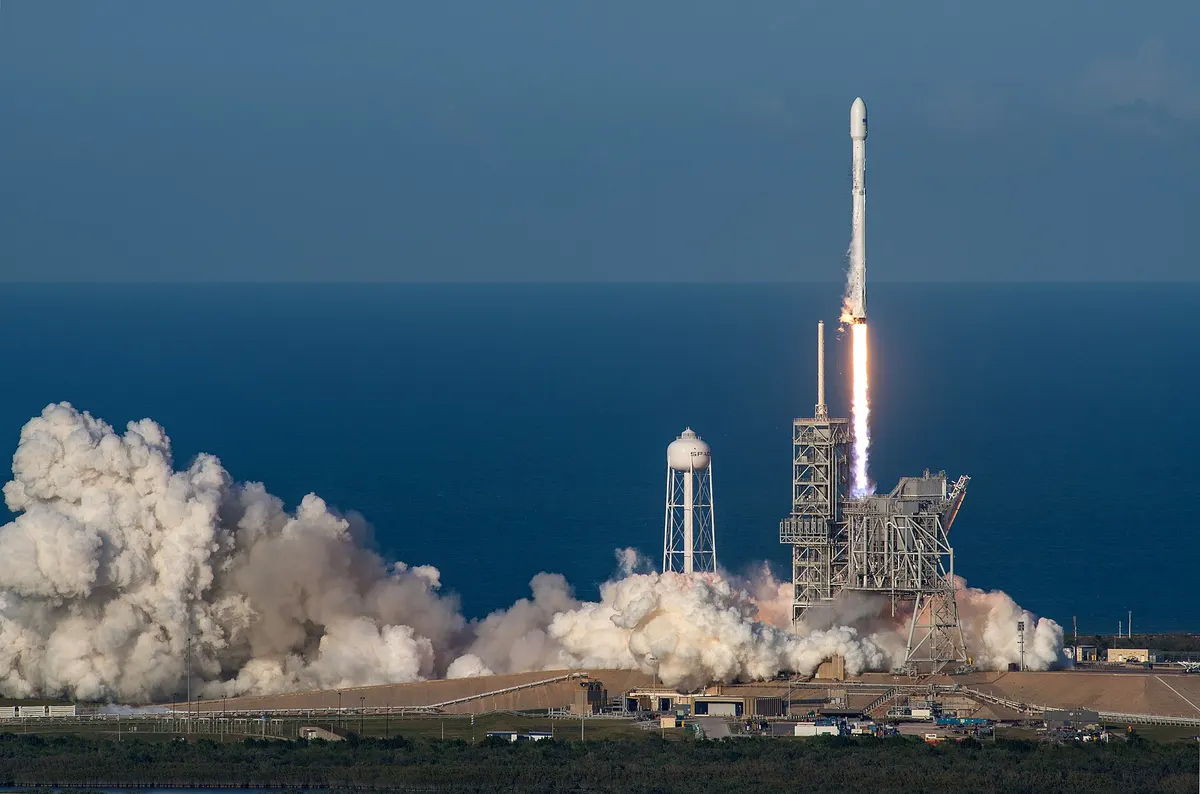
A SpaceX Falcon 9 rocket launched from Cape Canaveral Space Force Station in Florida, carrying Northrop Grumman's robotic Cygnus XL cargo ship toward the International Space Station. The flight marks the 25th resupply mission managed by Northrop Grumman for NASA.
The spacecraft, named the S.S. James "Jim" A. Lovell after the late commander of the Apollo 13 moon mission, is transporting 11,000 pounds of hardware, supplies, and scientific investigations. If flight plans proceed without interruption, the cargo freighter is scheduled to reach the orbiting laboratory.
What happened
The launch was scheduled for 10:47 a.m. EST from Florida's Cape Canaveral Space Force Station. Northrop Grumman's Cygnus XL freighter lifted off atop a SpaceX Falcon 9 rocket to begin its journey to the International Space Station. This mission marks the fourth flight for the Cygnus XL model, which is engineered to carry approximately 30 percent more cargo than previous iterations of the vehicle.
The cargo vessel is packed with 11,000 pounds, or 4,990 kilograms, of equipment. Among the payloads are multiple scientific research investigations. These include experiments designed to improve drug delivery methods for cancer and osteoarthritis, predict cancer spread, and advance treatments for muscle loss. Additional hardware aboard focuses on improving radiation sensing and advancing food production capabilities for future long-duration space missions.
Why it matters
Resupply missions are critical to the operational continuity of the International Space Station, sustaining the human crew living and working in orbit. The specialized scientific research carried to the station relies on the unique microgravity environment of space, which can reveal biological and physical processes impossible to study under Earth's gravity. The findings from these investigations aim to yield practical benefits for terrestrial medicine, such as improved cancer therapies and countermeasures for muscle degradation, alongside engineering insights required for future deep-space exploration.
The background
Northrop Grumman is a major aerospace and defense contractor that provides commercial resupply services to NASA under contracted mission programs. The company traditionally names its Cygnus spacecraft after notable spaceflight pioneers, with this particular vehicle honoring James "Jim" A. Lovell, the NASA astronaut who commanded the Apollo 13 mission and flew on three other spaceflights. Cygnus XL is one of four distinct robotic resupply vehicles servicing the space station, alongside Russia's Progress, Japan's HTV-X, and SpaceX's own Dragon capsule, which remains the sole reusable vehicle of the group that returns safely to Earth in one piece via parachute splashdown.
What happens next
According to mission plans, the S.S. James "Jim" A. Lovell is expected to arrive at the International Space Station. Upon arrival, NASA astronauts Jessica Watkins and Luke Delaney will operate the station's Canadarm2 robotic arm to capture the cargo freighter. The vehicle will subsequently be installed at the Earth-facing port of the station's Unity module for unloading by the crew. The spacecraft is scheduled to remain docked to the orbiting laboratory until May 2027, at which point it will be packed with thousands of pounds of station waste and directed to burn up harmlessly during reentry into Earth's atmosphere.
Key takeaways
- A SpaceX Falcon 9 rocket launched Northrop Grumman's Cygnus XL cargo ship from Cape Canaveral Space Force Station.
- The mission delivers 11,000 pounds of supplies, hardware, and scientific experiments to the International Space Station.
- The freighter is named the S.S. James "Jim" A. Lovell in honor of the late NASA astronaut and Apollo 13 commander.
- Scientific payloads on board include investigations into cancer treatments, osteoarthritis, muscle loss, radiation sensing, and space-based food production.