
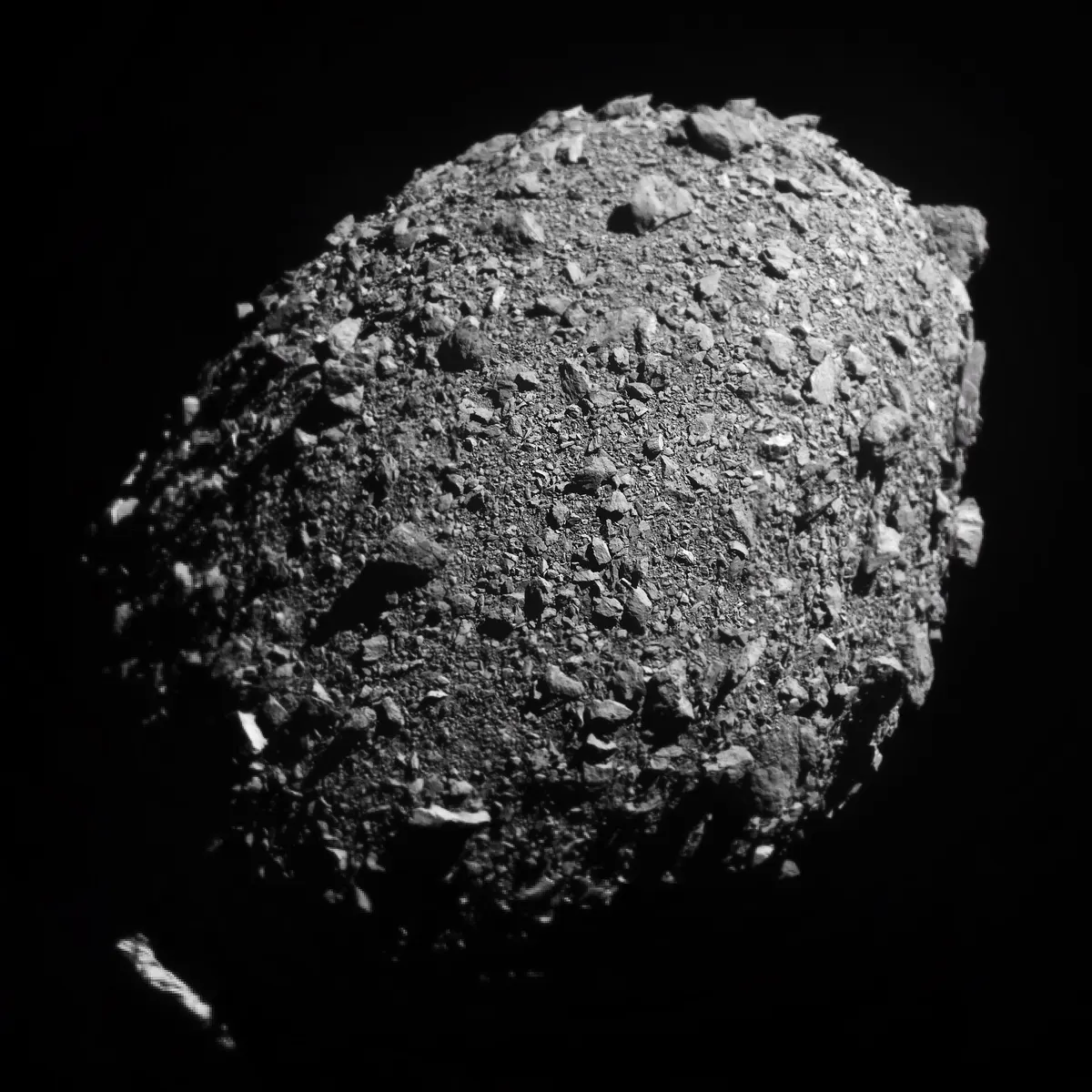
Four years after a NASA spacecraft deliberately smashed into an asteroid in a planetary defense test, a second mission has arrived to examine the aftermath. The European Space Agency's Hera probe is now at the scene to investigate how the collision altered the space rock.
The effort marks the first time humanity has ever attempted to physically alter the path of a celestial body. Scientists hope the combined data from both missions will help prepare Earth for any future asteroid threats.
What happened
In 2022, NASA's Double Asteroid Redirection Test, known as Dart, targeted a pair of space rocks. The target was Dimorphos, a small asteroid about 150 metres wide that orbits a larger companion called Didymos, which measures approximately 730 metres across.
The Dart spacecraft hurtled into Dimorphos at a speed of 22,000 kilometres per hour, utterly destroying itself on impact. The collision generated a debris trail measuring about 10,000 kilometres long that was visible to telescopes both in space and on Earth.
Before the crash, Dimorphos took 11 hours and 55 minutes to complete an orbit around Didymos. Following the impact, measurements revealed that the duration of its orbit had shrunk by approximately 33 minutes, proving that the spacecraft had successfully altered the asteroid's path.
Now, the European Space Agency's Hera spacecraft has arrived at the binary asteroid system to investigate the final state of Dimorphos. Because the Dart probe was completely obliterated upon impact, scientists still do not know whether the collision created a massive crater or completely reshaped the asteroid.
Hera is equipped with scientific instruments and two shoe-box-sized satellites designed to study the impact site up close and eventually land on the surface. A primary objective for Hera is to accurately measure the mass of Dimorphos to determine the exact effectiveness of the spacecraft's shove.
Why it matters
While the asteroid targeted in this test poses zero threat to Earth, medium-sized space rocks of similar dimensions are capable of wiping out an entire city if they were to strike our planet. Gathering precise intelligence on how asteroids react to kinetic impacts is vital for protecting humanity.
If scientists ever discover a hazardous asteroid on a collision course with Earth, they will need precise data to calculate the required mass, speed, and timing of a deflection mission. Understanding the physical composition and mass of Dimorphos provides the baseline required to make those critical calculations in the future.
The background
The Dart mission was developed by NASA alongside the Johns Hopkins Applied Physics Laboratory as a pioneering test of planetary defense. While the solar system contains far fewer potential threats than it did millions of years ago, astronomers acknowledge that there is a middle range of undiscovered space rocks that could pose risks.
The Hera mission serves as a follow-up investigation, acting as what scientists describe as an investigator returning to a crash scene to assess the outcome. Future efforts to monitor potentially hazardous space rocks include the scheduled 2027 launch of the Near-Earth Object Surveyor space telescope and planned visits to other asteroids like Apophis.
What happens next
The Hera mission will spend the next year studying both Dimorphos and Didymos. The spacecraft's onboard mini-satellites will conduct close-up studies of the impact site before eventually landing on the asteroid itself. Additionally, the first images captured by Hera upon its arrival are set to be released later on Wednesday.
Key takeaways
- A European Space Agency spacecraft named Hera has arrived at the binary asteroid system four years after a NASA probe collided with it.
- The original 2022 Dart crash successfully shortened the smaller asteroid's orbit around its larger companion by about 33 minutes.
- Hera will spend the next year measuring the mass of Dimorphos and investigating whether the impact created a crater or reshaped the rock.
- Researchers plan to use the data collected by these missions to refine planetary defense strategies against potential future asteroid threats to Earth.