
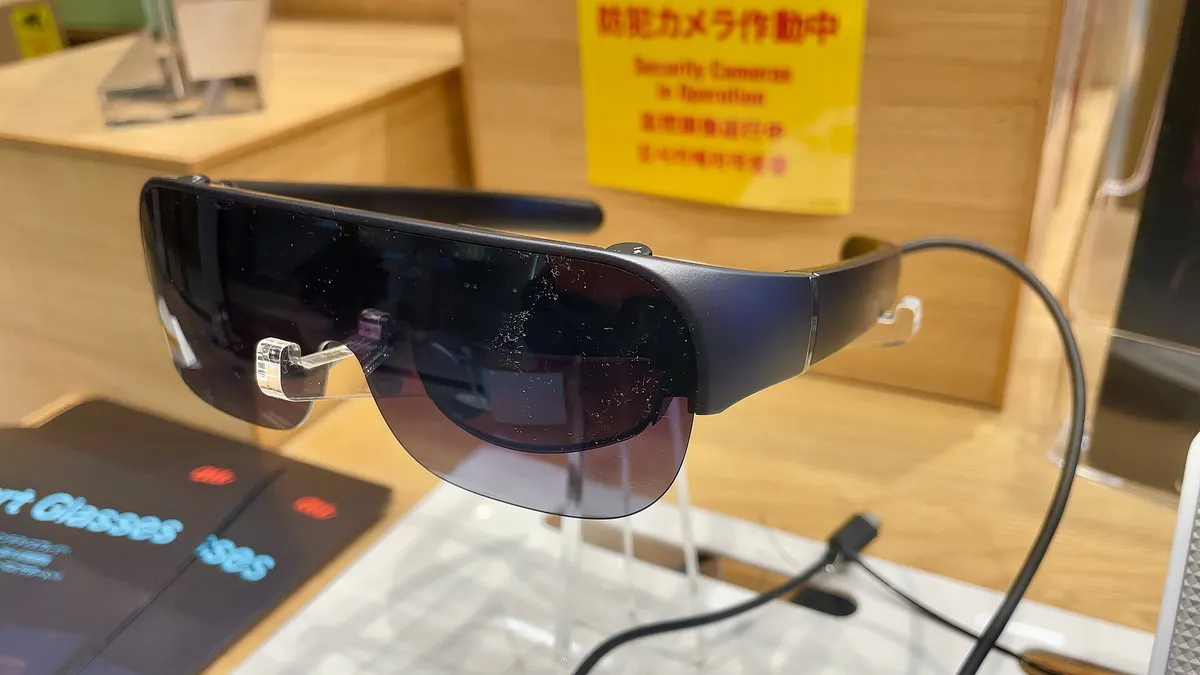
The Xreal Aura represents a major shift in mixed-reality hardware by shrinking Google's Android XR operating system into a sleek, lightweight pair of glasses connected to a pocket-sized compute puck. Priced starting at $1,099 during introductory offers before rising to $1,279, the device aims to solve the bulkiness problem that has long plagued headsets like the Apple Vision Pro and Samsung Galaxy XR.
Reviews indicate that while the hardware design and portability are major wins, users must weigh the high cost and modest battery life against whether Android XR's ecosystem has reached its full potential. The device connects software and hardware into a flexible package designed for entertainment, virtual workspaces, and professional enterprise uses.
What happened
Unveiled at Google's Android Developer Summit, the Xreal Aura splits its computing hardware from the eyewear to keep the glasses at a remarkably light 95 grams. The glasses feature dual Sony Micro-OLED displays delivering 1,920 by 1,200 resolution per eye at up to 120Hz, a 70-degree field of view, Bose-tuned spatial speakers, and integrated cameras for hand and gesture tracking. All processing and battery power are offloaded to a tethered compute puck. This puck is powered by Qualcomm's Snapdragon Reality Elite platform paired with 12GB or 16GB of RAM, up to 512GB of UFS 4.0 storage, and an active cooling fan. Because the puck can get warm during heavy tasks, Xreal includes a belt clip in the box. Reviewers noted that the device provides full Google Play Store access, supports multi-window virtual workspaces, and allows users to mirror laptops via USB-C. Battery life ranges between two to five hours depending on usage, and the introductory pricing starts at $1,099 for the base model.
Why it matters
Bulky standalone headsets have largely remained niche products because wearing a heavy visor on your face for hours is uncomfortable. By moving the heavy components into a separate pocket-sized puck, Xreal and Google are attempting to make spatial computing practical for everyday tasks, travel, and professional workflows. For enterprise users, applications like Frontline.io for remote maintenance and apoQlar's HoloMedicine for 3D medical scans offer functional possibilities. However, with a starting price well over one thousand dollars, consumers and businesses must carefully evaluate whether the portability and emerging software justify the financial investment.
The background
Historically, virtual reality headsets, augmented reality glasses, and mixed-reality devices have occupied distinct categories with separate use cases. Over the past year, tech companies have raced to build all-in-one mixed reality systems that blend digital content with the real world. Google developed Android XR to provide a dedicated operating system for spatial computing devices, powering headsets such as the Samsung Galaxy XR. Xreal is a well-known manufacturer of AR glasses that historically focused on expanding connected screens, but the Aura marks the company's boldest step into native spatial operating systems by adopting Google's platform.
What happens next
Shipments for the Xreal Aura are expected to begin in mid-November following its late-year debut. Reviewers note that while the hardware performs exceptionally well, questions remain regarding how well enterprise software tools will scale in real-world deployments and whether Google can continue expanding Android XR's must-have use cases. Long-term durability, sustained software updates, and the real-world performance of its Gemini AI integration will dictate how the platform evolves.
Key takeaways
- The Xreal Aura splits computing hardware into a tethered puck to keep the glasses at a lightweight 95 grams.
- Powered by Qualcomm's Snapdragon Reality Elite platform, the system runs Google's Android XR operating system and provides full Google Play Store access.
- Reviewers praised the comfortable design and gesture tracking, but noted that the compute puck gets warm and battery life is limited to a few hours.
- Introductory pricing starts at $1,099 before rising to a standard MSRP of $1,279 for the base model.