
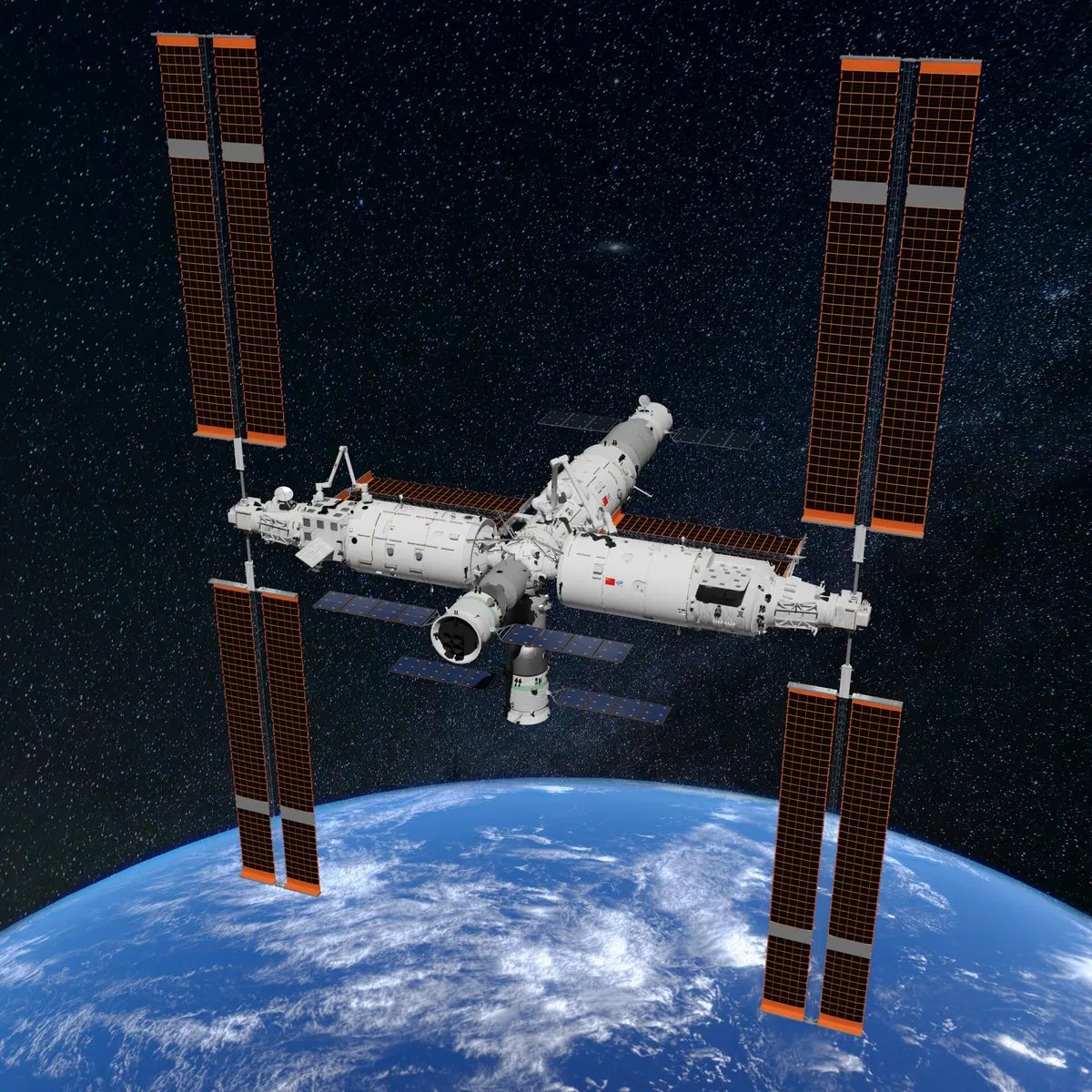
Muhammad Zeeshan Ali has entered orbit as part of the Shenzhou-24 mission, marking a historic achievement as both the first Pakistani in space and the first international visitor to board China's Tiangong space station. Pakistani Prime Minister Shehbaz Sharif and Chief of Defence Forces Field Marshal Syed Asim Munir celebrated the feat during a space-to-ground call from Islamabad, praising the partnership between Islamabad and Beijing.
The mission highlights growing space collaboration between the two nations following a bilateral agreement signed in February 2025. Ali's journey serves as a powerful symbol of their long-standing diplomatic and strategic ties.
What happened
Ali lifted off from the Gobi desert in China on a Long March 2F rocket alongside Chinese commander Tang Hongbo and flight engineer Wu Yi. Their spacecraft successfully docked at the Tiangong space station roughly six hours later, allowing Ali to step inside the orbital outpost as a payload specialist. While his Chinese crewmates are scheduled to remain aboard the station for a standard six-month rotation, Ali will spend only a week in orbit before returning to Earth alongside returning crew members from the previous Shenzhou-23 mission. During his brief stay, Ali is tasked with conducting collaborative scientific experiments in biotechnology and materials, including studies on photosynthetic cyanobacteria and the impact of radiation on seeds.
Why it matters
The flight represents a significant diplomatic and technological victory for Beijing, which is working to position its Tiangong space station as an international research hub and an alternative to Western-led space efforts. For Pakistan, the mission provides a direct gateway into crewed spaceflight for a nation that lacks its own domestic spacecraft capable of carrying human astronauts. Prime Minister Shehbaz Sharif noted that the historic milestone coincides with the 75th anniversary of diplomatic relations between the two countries, cementing an alliance that leaders in both capitals described as reaching far beyond terrestrial boundaries.
The background
China assembled its three-module Tiangong space station in late 2022 as a permanent crewed laboratory in low Earth orbit. The station typically hosts rotating teams of three astronauts for six-month stints, supported by the Shenzhou transport spacecraft series. Although other citizens of Pakistan have previously reached space through private suborbital tourism flights, Ali is the first to achieve orbital flight and the first foreign national officially integrated into a Chinese crewed mission. To prepare for the flight, Ali and fellow backup candidate Khurram Dawood underwent intensive training under Chinese supervision, which included mastering the Mandarin language.
What happens next
Ali is scheduled to complete his research agenda and return to Earth within a week of his arrival, hitching a ride home with members of the outgoing Shenzhou-23 crew. Meanwhile, commander Tang Hongbo and flight engineer Wu Yi will continue their six-month mission aboard Tiangong. China plans to further expand the station in the future and aims to land Chinese astronauts on the moon by 2030.
Key takeaways
- Muhammad Zeeshan Ali became the first Pakistani in orbit and the first foreign astronaut to enter China's Tiangong space station.
- Ali traveled to orbit aboard the Shenzhou-24 spacecraft alongside Chinese commander Tang Hongbo and flight engineer Wu Yi.
- Pakistani Prime Minister Shehbaz Sharif and Field Marshal Syed Asim Munir congratulated Ali via a live space-ground call from Islamabad.
- Ali will conduct joint experiments on biotechnology, materials, and cyanobacteria before returning to Earth after a one-week stay.