
The European Space Agency has captured the first close-up images of an asteroid struck by a NASA spacecraft in a historic planetary defense test. The new pictures reveal that the collision carved out a massive crater nearly as wide as the asteroid itself and threw hundreds of boulders into surrounding space.
The findings mark a major step in humanity's ability to deflect potentially dangerous celestial objects away from Earth. By combining data from the initial impact and the new spacecraft observations, scientists are learning how small bodies respond to high-speed collisions.
What happened
In September 2022, NASA deliberately crashed its half-ton Double Asteroid Redirection Test spacecraft into a small near-Earth asteroid called Dimorphos at about 14,000 miles per hour. The target asteroid, which measures roughly 151 meters wide, orbits a larger companion asteroid named Didymos from a distance of millions of miles. While neither body poses any threat to our planet, the pair was chosen to test whether a kinetic impactor could successfully alter a celestial path.
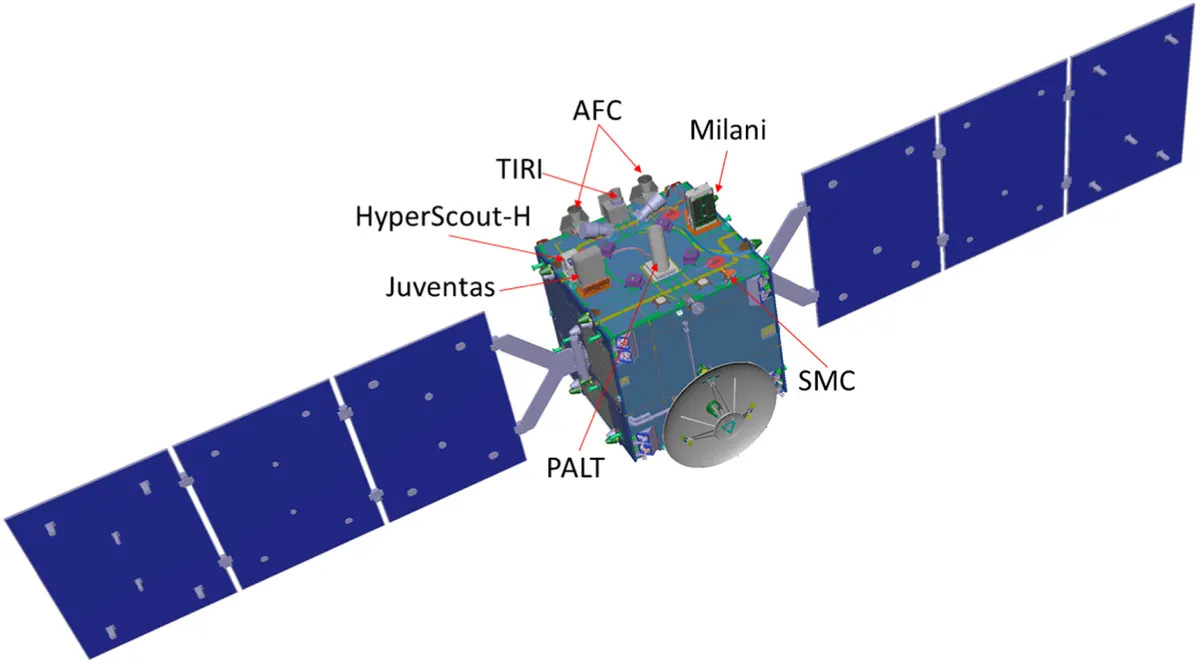
Initial observations from Earth-based telescopes revealed that the high-speed crash shortened the time Dimorphos takes to orbit Didymos by about 33 minutes. Now, the European Space Agency's Hera spacecraft has arrived to document the physical aftermath. Operating from about 25 to 30 kilometers away, Hera used its specialized cameras and thermal infrared imagers to photograph the crash site.
The images show an impact crater so large it extends across the entire width of Dimorphos, leading scientists to describe the damage as though a piece of the asteroid was cut away. Researchers noted that the impacted side is completely covered by the crater, while the opposite side shows no evidence of major changes. Besides carving out the basin, the collision sent Dimorphos tumbling in a chaotic way, with researchers comparing its erratic motion to a barrel rolling down a flight of stairs. Hera also discovered hundreds of orbiting boulders, ranging in size from footballs to washing machines, swirling around the asteroid system.
Why it matters
Developing a reliable method to deflect asteroids is crucial for safeguarding the Earth against potential future impacts from doomsday space rocks. The DART mission served as a proof-of-concept to show that altering the trajectory of a celestial object is physically possible. Hera's follow-up observations are essential for translating that success into a predictable tool, allowing scientists to understand how much energy is required to move an asteroid and how the internal structure of these bodies reacts to extreme force.
The background
Planetary defense has grown from science fiction into a serious scientific endeavor as space agencies catalogue near-Earth objects. NASA launched the DART mission to test kinetic impact technology, which relies on the momentum of a fast-moving spacecraft to nudge an asteroid off course. Dimorphos and Didymos form a binary system, making it easier for astronomers to measure changes in orbital periods using ground-based telescopes. Following the successful 2022 impact, the European Space Agency dispatched the Hera spacecraft to inspect the damage up close and gather comprehensive data on the asteroid's mass and composition.
What happens next
In December, the European Space Agency plans to maneuver Hera closer to Dimorphos and Didymos to capture higher-resolution images of the impact site. In January, the spacecraft will deploy two shoebox-sized CubeSats to gather deeper scientific data. A Luxembourg-led team's Juventas satellite will use radar to probe the asteroid's interior before eventually landing on its surface, while an Italian-led team's Milani satellite will prospect for asteroid dust and surrounding materials to help researchers measure the mass of Dimorphos.
Key takeaways
- The European Space Agency's Hera mission captured the first close-up images of the aftermath from NASA's 2022 asteroid impact.
- The deliberate crash carved a stadium-sized crater that spans nearly the entire width of the 151-meter-wide asteroid Dimorphos.
- The collision altered the rotation of Dimorphos, leaving the celestial body tumbling chaotically in its new orbit around Didymos.
- Hera also discovered hundreds of boulders, ranging from the size of footballs to washing machines, swirling around the asteroid system.
- Future mission phases will deploy small satellites to probe the asteroid's interior with radar and measure its overall mass.